HCPC OET English Requirements in 2026
The Health and Care Professions Council (HCPC) regulates 15 allied health professions in the UK — physiotherapists, occupational therapists, radiographers, paramedics, dietitians, podiatrists, speech and language therapists and more. This guide covers the exact OET score required, score combining across two sittings, who qualifies for exemption, and the most efficient path to Grade B in writing.

Key takeaways
- Required score: Grade B (350) in each of the four OET sub-tests.
- Professions covered: 15 allied health roles including physio, OT, radiography, paramedics and dietetics.
- Score combining: Allowed across two sittings within a 6-month window. Kept sub-tests need at least Grade C+ (300).
- IELTS alternative: 7.0 overall with at least 6.5 in each component.
- Validity: 2 years from test date at application submission.
All 15 HCPC-Regulated Professions: OET Requirements
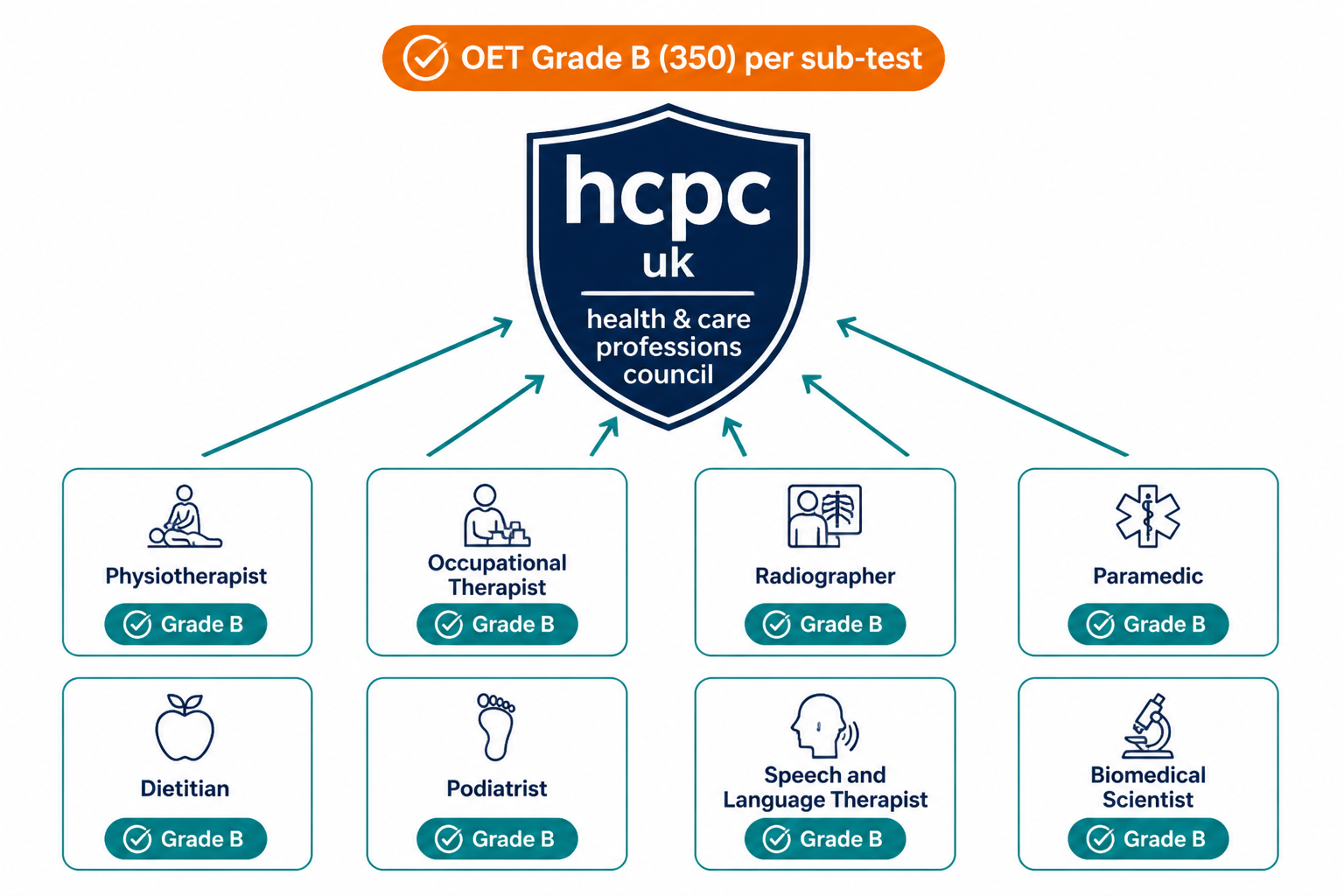
Every profession regulated by the HCPC must meet the same English language threshold. Grade B (350) in each of the four OET sub-tests, or the IELTS Academic equivalent.
| Profession | OET grade required | Score combining | IELTS alternative |
|---|---|---|---|
| Physiotherapist | Grade B (350) all 4 sub-tests | Yes, 6-month window | 7.0 overall / 6.5 each |
| Occupational Therapist | Grade B (350) all 4 sub-tests | Yes, 6-month window | 7.0 overall / 6.5 each |
| Radiographer (diagnostic & therapeutic) | Grade B (350) all 4 sub-tests | Yes, 6-month window | 7.0 overall / 6.5 each |
| Paramedic | Grade B (350) all 4 sub-tests | Yes, 6-month window | 7.0 overall / 6.5 each |
| Dietitian | Grade B (350) all 4 sub-tests | Yes, 6-month window | 7.0 overall / 6.5 each |
| Podiatrist | Grade B (350) all 4 sub-tests | Yes, 6-month window | 7.0 overall / 6.5 each |
| Speech & Language Therapist | Grade B (350) all 4 sub-tests | Yes, 6-month window | 7.0 overall / 6.5 each |
| Biomedical Scientist | Grade B (350) all 4 sub-tests | Yes, 6-month window | 7.0 overall / 6.5 each |
| Clinical Scientist | Grade B (350) all 4 sub-tests | Yes, 6-month window | 7.0 overall / 6.5 each |
| Operating Dept Practitioner | Grade B (350) all 4 sub-tests | Yes, 6-month window | 7.0 overall / 6.5 each |
| Practitioner Psychologist | Grade B (350) all 4 sub-tests | Yes, 6-month window | 7.0 overall / 6.5 each |
| Arts Therapist | Grade B (350) all 4 sub-tests | Yes, 6-month window | 7.0 overall / 6.5 each |
| Hearing Aid Dispenser | Grade B (350) all 4 sub-tests | Yes, 6-month window | 7.0 overall / 6.5 each |
| Orthoptist | Grade B (350) all 4 sub-tests | Yes, 6-month window | 7.0 overall / 6.5 each |
| Prosthetist / Orthotist | Grade B (350) all 4 sub-tests | Yes, 6-month window | 7.0 overall / 6.5 each |
Source: HCPC English language requirements (2026). Confirm current policy with the HCPC before applying.
The Required Scores at a Glance
The HCPC publishes its English language requirements on its official website. The thresholds below reflect 2026 policy.
| Sub-test | Minimum (single sitting) | Minimum (combined sittings) |
|---|---|---|
| Listening | Grade B (350) | Grade C+ (300) or above in earlier sitting |
| Reading | Grade B (350) | Grade C+ (300) or above in earlier sitting |
| Writing | Grade B (350) | Grade C+ (300) or above in earlier sitting |
| Speaking | Grade B (350) | Grade C+ (300) or above in earlier sitting |
Why Writing Trips Up Allied Health Applicants
In over 11,000 letters I have personally marked as lead corrector at WCS, allied health professionals fail OET Writing for a profession-specific reason: documentation training teaches them structured assessment formats (SOAP, problem-oriented notes, outcome-measure sheets) that transfer poorly to letter genre. The clinical English is strong; the letter format is unfamiliar.
The shorthand habit
AROM, PROM, MMT, BD, TDS, abbreviated outcome scores — all documentation register. OET letter prose requires expansion to full clinical English. This single change reliably moves Genre & Style scores up a band.
Letter genre is teachable
Profession-specific letter conventions can be learned in three to five professionally corrected letters. Volume practice without expert feedback usually plateaus.
The most efficient HCPC pathway
- 1. Sit OET once aiming for Grade B in all four sub-tests.
- 2. If Writing falls short — get three letters professionally corrected for your specific allied health discipline.
- 3. Sit OET again within six months. Retake Writing only. Combine scores.
- 4. Submit to HCPC within two years of your earlier sitting.
Profession-Specific Guides
OET for Physiotherapists
Profession-specific guidance for physios preparing for HCPC registration.
OET for Occupational Therapists
OT-specific letter conventions and the discharge letter pattern that scores Grade B.
OET for Radiographers
Reporting style and referral letter format for diagnostic and therapeutic radiographers.
OET for Dietitians
Advice letter format for dietitians preparing for HCPC registration.
OET for Podiatrists
Referral letter conventions for podiatrists.
OET for Speech and Language Therapists
Profession-specific letter pattern for SLTs.
HCPC OET Frequently Asked Questions
What OET score does the HCPC require?
Which professions register with the HCPC?
Can I combine OET scores for HCPC?
Does the HCPC accept IELTS instead of OET?
How recent must my OET score be?
Are there exemptions for the HCPC English requirement?
Stuck below Grade B on OET for HCPC registration? Dr Mariam's expert OET writing correction service marks every letter against all six OET writing criteria and returns line-by-line corrections within 24–72 hours.
See how it works