OET Writing Retake Guide
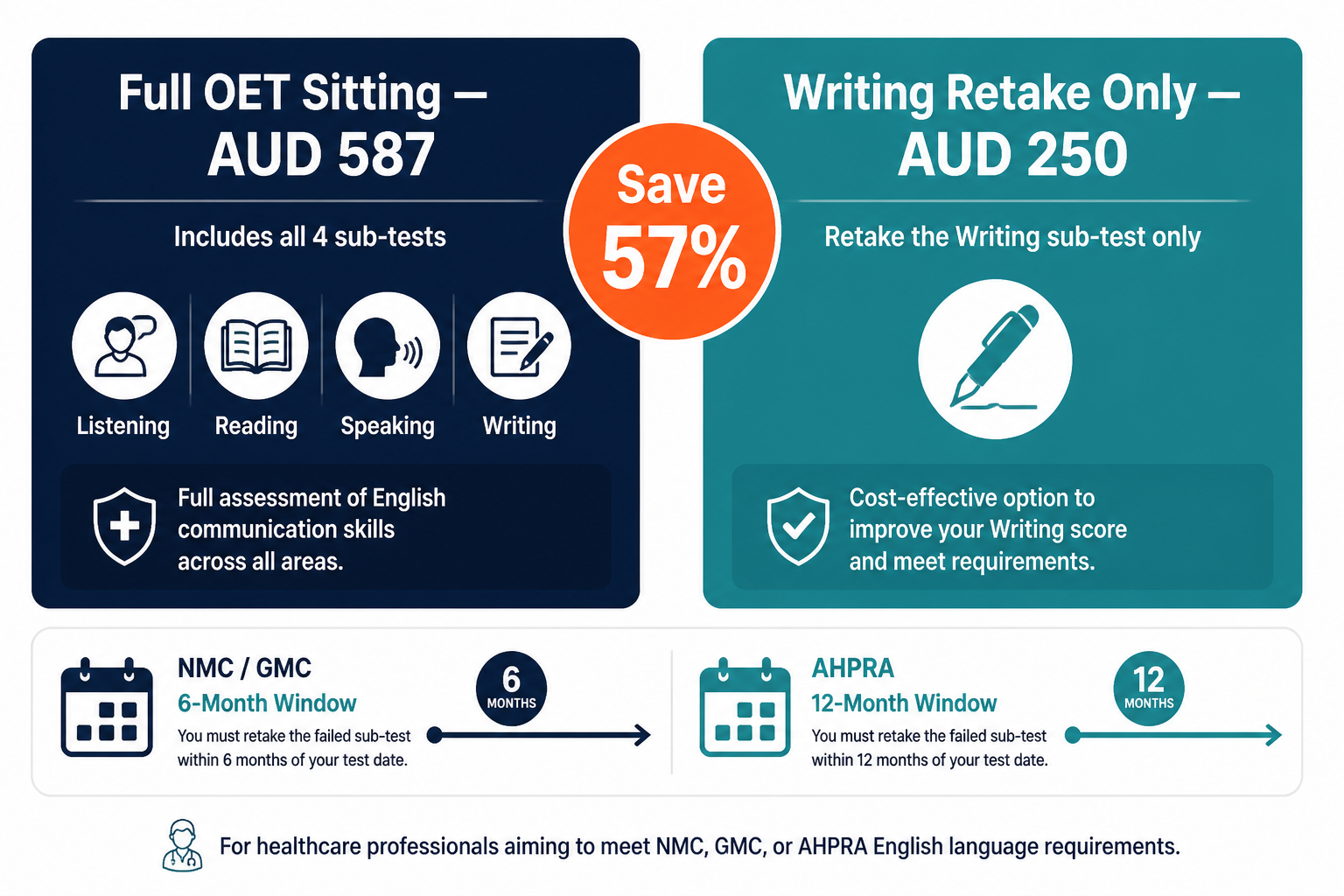
You can retake only the Writing sub-test if you scored Grade C+ (300) or above, keeping your other scores through score combining. A single sub-test costs around USD 165, versus roughly USD 587 for a full sitting. Below: the combining rules by regulator, the eligibility and single-sitting caveats, why candidates fail Writing, and the four-to-eight-week plan that turns the resit into a pass.
Key takeaways
- You can retake just Writing. OET allows single sub-test retakes (~AUD/USD 165), far cheaper than a full sitting (~AUD/USD 587).
- Score combining is accepted by the NMC (two sittings) and AHPRA (two sittings within 12 months). The GPhC does not accept combined sittings.
- Wait 4–8 weeks before retaking. Booking too early almost always produces the same result.
- Five recurring failure patterns account for almost every Grade C result; language ability is rarely one of them.
- Three to five corrected letters typically reveal the patterns blocking Grade B that are otherwise invisible to the writer.
How much does it cost to retake just OET Writing?
Retaking only the Writing sub-test is significantly cheaper than sitting the full OET again. 2026 fees from the official OET fee schedule:
Fees confirmed from the official OET website. USD conversions are approximate. Prices may vary by test centre or country.
Should you retake or request a re-mark?
Both are legitimate options after a borderline result. The right choice depends on your score, how many criteria were weak, and your timeline.
| Signal | Request a re-mark | Book a retake |
|---|---|---|
| Your Writing score | 340–349 (just below Grade B = 350) | Below 330 (clear C+ or C result) |
| Criteria below B | 1–2 criteria at borderline bands | 3+ criteria below B, or one clearly low |
| Your confidence in the letter | You felt you wrote well on the day | You spotted errors yourself during the test |
| Time pressure | Result needed in 4–6 weeks (re-mark is faster) | You have 8–12 weeks to prepare properly |
| Cost | AUD 120 / ~USD 80 (lower upfront) | AUD 250 / ~USD 165 (still far below full re-sit) |
Re-marking does not guarantee a higher score. OET states that roughly 1 in 5 re-marks results in a score change. If your result is clearly below Grade B, a retake with targeted preparation is more reliable.
Which regulators let you retake one sub-test?
Some regulators accept combined OET results across two sittings, which means you can retake only Writing and keep your other scores. Combining rules vary by regulator.
Always confirm the current rules with your specific regulator. Combining rules differ by regulator, and each regulator sets its own minimum score for each sub-test.
Why do candidates fail OET Writing?
Across 11,000+ corrected letters since 2014, the patterns are remarkably consistent. Almost no one fails Writing because of language ability. The five issues below account for the overwhelming majority of Grade C results.
Each pattern below maps to one of these fixes. Most Grade C candidates are blocked by just one or two of them, which is why a small number of corrected letters reveals the gap so quickly.
Case-note over-inclusion
Including everything in the case notes rather than only what the recipient needs. Damages Content, Conciseness, and Organisation simultaneously. The fix: highlight what's relevant before writing, and accept that 'irrelevant' is a deliberate choice.
Missing or unclear purpose
Opening with patient demographics or clinical history rather than 'I am writing to refer/inform/request...'. The fix: every letter opens with action verb + patient + age + reason for writing. Always.
Register inconsistency
Starting formally and drifting into clinical shorthand or conversational phrasing. One informal paragraph in an otherwise formal letter pulls Genre & Style down by a full band. The fix: read your letter back as a whole, listening for tone shifts.
Bullet-listing case notes
Reproducing case notes as a list rather than weaving them into clinical prose. Examiners cannot reward Content or Organisation if the candidate hasn't actually composed a letter. The fix: paraphrase. Even strong terminology should sit in your own sentence structure.
Casual closings
'Thanks for your help' or 'Hope this is OK': SMS register at the end of an otherwise formal letter. The fix: closing with a specific clinical action ('I would appreciate your assessment for consideration of joint replacement') keeps register consistent and earns Purpose marks.
How do you pass OET Writing on the retake?
Most candidates moving from Grade C to Grade B see measurable improvement within 4–8 weeks of focused practice with feedback. The bottleneck is feedback quality, not practice volume.
Diagnose
Submit one letter for professional correction. Detailed feedback reveals which of the six criteria are blocking your Grade B; almost always one or two specific patterns, not all six.
Target the gap
Write 3–5 letters focused on the specific weakness. If your gap is case-note selection, every practice letter tests that one skill until it becomes automatic.
Generalise
Practise across all four letter types (referral, discharge, transfer, advice) and across multiple case scenarios. Submit at least one letter per letter type for correction.
Confirm under exam conditions
Sit two final letters under timed conditions and have them corrected. If both score Grade B, you are exam-ready. If one drops, the gap is timing or stamina, not skill.
The single biggest mistake on retake
Booking the retake too soon and writing more letters without expert correction. This produces the same result twice. The candidates who pass the second sitting almost always credit a small number of professionally corrected letters (typically three to five) for revealing the patterns that previously felt invisible.
View correction packagesRelated Guides
How to Get Grade B in OET Writing
Six-criteria breakdown and the four reasons most candidates miss Grade B.
4 Annotated Letter Samples
Three Grade B letters and one Grade C diagnostic letter: see exactly what separates them.
NMC OET Requirements
UK nurses: score combining, validity, exemptions.
AHPRA OET Requirements
Australian healthcare professionals: 12-month combining window in detail.
GMC English Requirements
UK doctors: OET requirements and validity.
OET Case Notes Practice
Three sample case-notes blocks plus the AI Case Note Generator.
OET Writing Retake FAQ
Can I retake just OET Writing?
How long should I wait before retaking OET Writing?
Why do candidates fail OET Writing on first attempt?
How much does it cost to retake OET Writing?
Should I request a re-mark or book a retake?
Stuck below Grade B on OET writing? Dr Mariam's expert OET writing correction service marks every letter against all six OET writing criteria and returns line-by-line corrections within 24–72 hours.
See how it works