What your money buys
A sample OET writing correction, start to finish
This is one doctor's referral letter, corrected the way we correct every letter. Below is everything that comes back: the score, the marks, each correction and why, the letter rewritten, and a study plan for the next one.
This is a sample
In a real correction of your own letter, you get:
- every mistake corrected and explained, one by one
- a conciseness and paraphrasing lesson on your case notes: what to keep, what to leave out, and how each note becomes a letter sentence
- grammar lessons built from your own mistakes, with exercises
In short
- Every letter gets an estimated score out of 500, a grade and all six OET criterion marks.
- Each mistake is shown with a better version and the reason, sorted by paragraph.
- You also get your letter rewritten, a study plan and a PDF report to keep.
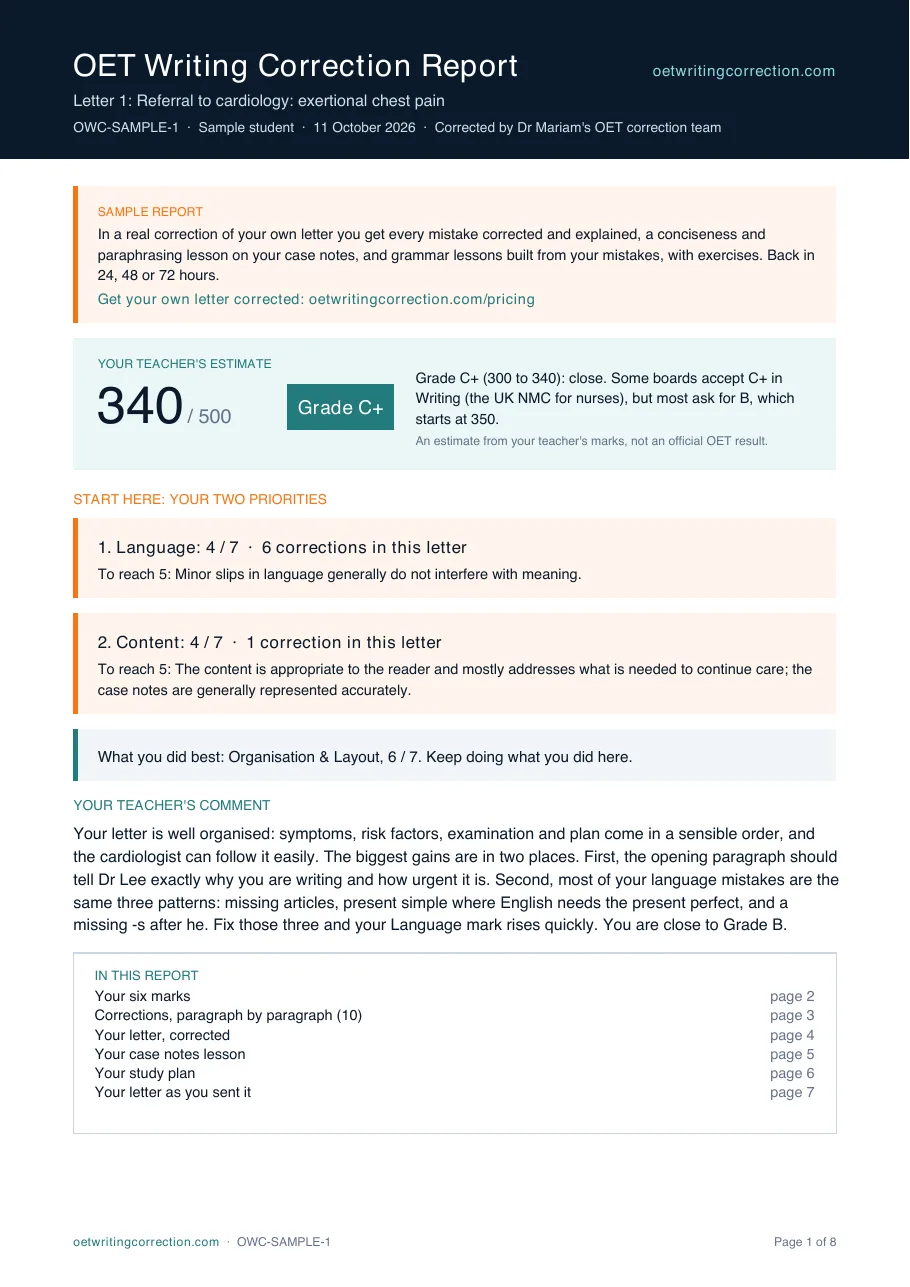
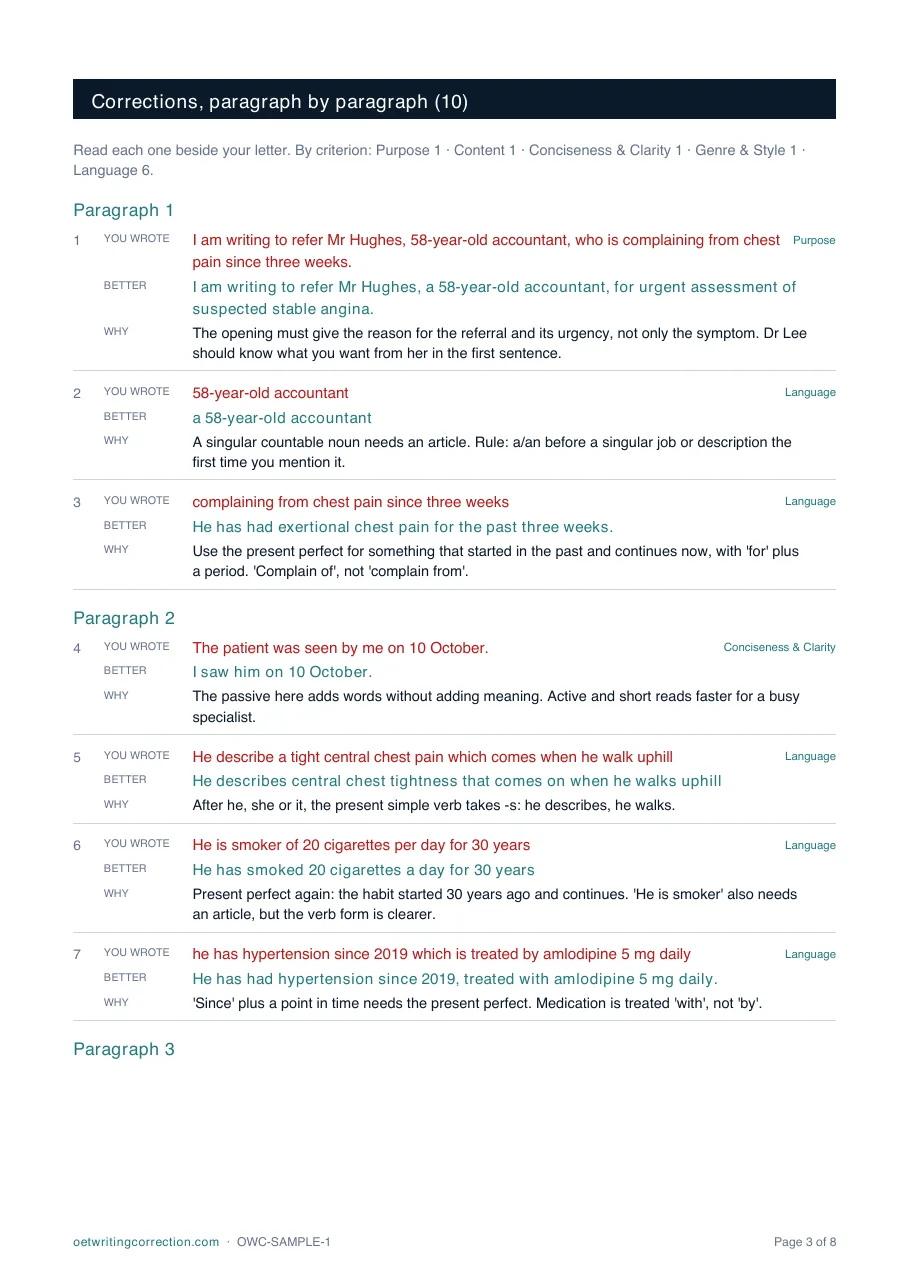
What comes back with every corrected letter
The same parts, in the same order, whichever pack you buy.
| Part | What it tells you | In this sample |
|---|---|---|
| Score and grade | Where the letter stands on OET's 0 to 500 scale, and what the grade means for registration | 340 / 500, Grade C+ |
| Six criterion marks | Your mark for each OET criterion and what the next mark up needs | 2/3 · 4/7 · 5/7 · 5/7 · 6/7 · 4/7 |
| Two priorities | The two criteria that will move your score most | Language and Content |
| Corrections | Each mistake, a better version and why, by paragraph and criterion | 10 corrections |
| Your letter, corrected | Your own letter with every correction applied, to read aloud and rewrite | Full letter |
| Case notes lesson | Conciseness: which notes this reader needs and why. Paraphrasing: how each note becomes a letter sentence | 11 notes, 7 paraphrases |
| Study plan | Grammar you keep breaking, words to change, phrases to keep, practice sentences, next steps | 3 grammar points, 5 words, 4 practice sentences |
| PDF report | All of the above in a printable report, attached to your email | About 7 pages (the sample adds a page on our packs) |
| Letters page | Every letter you have sent, its status, and a chart of your scores over time | Your own private link |
1. The task and the letter sent
A sample we wrote for this page, with the mistakes we see most often in doctors' referral letters.
Case notes (summary)
Patient: Mr Daniel Hughes, DOB 14/03/1967, accountant, 58.
Seen 10 Oct: 3-week history of central chest tightness on walking uphill, settles after about 5 min rest. No pain at rest.
Risk factors: smoker, 20/day for 30 years. Hypertension since 2019 (amlodipine 5 mg daily). Father: MI aged 60. Total cholesterol 6.8 mmol/L.
Examination: BP 152/94, pulse 78 regular. ECG: no acute changes.
Plan: aspirin 75 mg daily, GTN spray PRN, smoking cessation advice.
Task: refer to Dr Sarah Lee, Cardiologist, Northfield Hospital, for urgent assessment.
The letter as sent
Dr Sarah Lee Cardiology Department Northfield Hospital
10 October 2026
Dear Dr Lee,
Re: Mr Daniel Hughes, DOB 14/03/1967
I am writing to refer Mr Hughes, 58-year-old accountant, who is complaining from chest pain since three weeks.
The patient was seen by me on 10 October. He describe a tight central chest pain which comes when he walk uphill and goes after rest for 5 minutes. He is smoker of 20 cigarettes per day for 30 years and he has hypertension since 2019 which is treated by amlodipine 5 mg daily. His father had a heart attack at age 60.
On examination, his blood pressure was 152/94 and his pulse was 78 and regular. ECG showed no acute changes. I have started him on aspirin 75 mg daily and GTN spray as needed, and I advised him to stop smoking.
I would be grateful if you could see him urgently and do further investigations. Please don't hesitate to contact me if you need any further informations.
Yours sincerely,
Doctor
2. The score, and where to start
Your teacher's estimate
340 / 500 Grade C+
Grade C+ (300 to 340): close. Some boards accept C+ in Writing (the UK NMC for nurses), but most ask for B, which starts at 350.
An estimate from the six marks, not an official OET result.
Start here: your two priorities
1. Language: 4 / 7 · 6 corrections
To reach 5: Minor slips in language generally do not interfere with meaning.
2. Content: 4 / 7 · 1 correction
To reach 5: The content is appropriate to the reader and mostly addresses what is needed to continue care; the case notes are generally represented accurately.
Your teacher's comment
Your letter is well organised: symptoms, risk factors, examination and plan come in a sensible order, and the cardiologist can follow it easily. The biggest gains are in two places. First, the opening paragraph should tell Dr Lee exactly why you are writing and how urgent it is. Second, most of your language mistakes are the same three patterns: missing articles, present simple where English needs the present perfect, and a missing -s after he. Fix those three and your Language mark rises quickly. You are close to Grade B.
3. The six marks
Each OET writing criterion, the mark, and what the next mark up needs, in OET's own level descriptors.
| Criterion | Mark | Status | To reach the next mark |
|---|---|---|---|
| Purpose | 2 / 3 | Focus here | 3: The purpose of the letter is immediately apparent and sufficiently expanded. |
| Content | 4 / 7 | Focus here | 5: The content is appropriate to the reader and mostly addresses what is needed to continue care; the case notes are generally represented accurately. |
| Conciseness & Clarity | 5 / 7 | Nearly there | 7: The length suits the case and the reader, with nothing irrelevant; information is summarised effectively and presented clearly. |
| Genre & Style | 5 / 7 | Nearly there | 7: The writing is clinical, factual and appropriate to the reader; technical language, abbreviations and polite language are used appropriately. |
| Organisation & Layout | 6 / 7 | Strong | 7: Organisation and paragraphing are appropriate, logical and clear; key information is highlighted and the letter is well laid out. |
| Language | 4 / 7 | Focus here | 5: Minor slips in language generally do not interfere with meaning. |
4. The corrections, paragraph by paragraph
10 corrections. Each says what was written, a better version, and the reason, so the same mistake does not come back.
| # | You wrote | Better | Why | Criterion |
|---|---|---|---|---|
| 1Paragraph 1 | I am writing to refer Mr Hughes, 58-year-old accountant, who is complaining from chest pain since three weeks. | I am writing to refer Mr Hughes, a 58-year-old accountant, for urgent assessment of suspected stable angina. | The opening must give the reason for the referral and its urgency, not only the symptom. Dr Lee should know what you want from her in the first sentence. | Purpose |
| 2Paragraph 1 | 58-year-old accountant | a 58-year-old accountant | A singular countable noun needs an article. Rule: a/an before a singular job or description the first time you mention it. | Language |
| 3Paragraph 1 | complaining from chest pain since three weeks | He has had exertional chest pain for the past three weeks. | Use the present perfect for something that started in the past and continues now, with 'for' plus a period. 'Complain of', not 'complain from'. | Language |
| 4Paragraph 2 | The patient was seen by me on 10 October. | I saw him on 10 October. | The passive here adds words without adding meaning. Active and short reads faster for a busy specialist. | Conciseness & Clarity |
| 5Paragraph 2 | He describe a tight central chest pain which comes when he walk uphill | He describes central chest tightness that comes on when he walks uphill | After he, she or it, the present simple verb takes -s: he describes, he walks. | Language |
| 6Paragraph 2 | He is smoker of 20 cigarettes per day for 30 years | He has smoked 20 cigarettes a day for 30 years | Present perfect again: the habit started 30 years ago and continues. 'He is smoker' also needs an article, but the verb form is clearer. | Language |
| 7Paragraph 2 | he has hypertension since 2019 which is treated by amlodipine 5 mg daily | He has had hypertension since 2019, treated with amlodipine 5 mg daily. | 'Since' plus a point in time needs the present perfect. Medication is treated 'with', not 'by'. | Language |
| 8Paragraph 3 | (not mentioned) | His total cholesterol was raised at 6.8 mmol/L. | The case notes give a raised cholesterol. It is a cardiac risk factor, so the cardiologist needs it. Leaving it out costs you on Content. | Content |
| 9Paragraph 4 | see him urgently and do further investigations | assess him urgently and arrange any further investigations you consider appropriate | Writing to a specialist, leave the choice of tests to her. 'Do investigations' is too informal for this reader. | Genre & Style |
| 10Paragraph 4 | Please don't hesitate to contact me if you need any further informations. | Please do not hesitate to contact me if you require further information. | No contractions in a formal letter. 'Information' is uncountable: it never takes -s. | Language |
5. The letter, corrected
Your own letter with every correction applied: your content, your order. Read it aloud once, then rewrite it from memory.
Dr Sarah Lee Cardiology Department Northfield Hospital
10 October 2026
Dear Dr Lee,
Re: Mr Daniel Hughes, DOB 14/03/1967
I am writing to refer Mr Hughes, a 58-year-old accountant, for urgent assessment of suspected stable angina. He has had exertional chest pain for the past three weeks.
I saw him on 10 October. He describes central chest tightness that comes on when he walks uphill and settles after about five minutes of rest. He has smoked 20 cigarettes a day for 30 years and has had hypertension since 2019, treated with amlodipine 5 mg daily. His father had a myocardial infarction at the age of 60, and his total cholesterol was raised at 6.8 mmol/L.
On examination, his blood pressure was 152/94 mmHg and his pulse was 78 and regular. His ECG showed no acute changes. I have started him on aspirin 75 mg daily and a GTN spray as required, and I have advised him to stop smoking.
I would be grateful if you could assess him urgently and arrange any further investigations you consider appropriate. Please do not hesitate to contact me if you require further information.
Yours sincerely,
Doctor
6. The case notes lesson
Conciseness & Clarity and Content are won before you write a word. Your teacher goes through your case notes: what this reader needs, what to leave out, and how notes become sentences.
Keep or leave out
- KeepDOB 14/03/1967, 58Name, date of birth and age identify the patient: put them in the Re: line and the opening sentence.
- Leave outAccountantHis job does not change Dr Lee's assessment of his chest pain. You put it in your opening; it pushes the reason for writing further back.
- Keep3-week history of central chest tightness on walking uphillThis is why you are referring him: it belongs in the first paragraph with the request.
- KeepSettles after about 5 min rest. No pain at rest.Pain on exertion that settles with rest, and none at rest, is exactly what the cardiologist needs to judge how stable it is. You left out "no pain at rest".
- KeepSmoker, 20/day for 30 yearsA major cardiac risk factor, with the amount that shows how important it is.
- KeepHypertension since 2019 (amlodipine 5 mg daily)A risk factor and his current treatment: Dr Lee needs both.
- KeepFather: MI aged 60Family history of heart disease is a risk factor.
- KeepTotal cholesterol 6.8 mmol/LA raised cholesterol completes the risk-factor picture. It is missing from your letter, and it costs marks for Content.
- KeepBP 152/94, pulse 78 regularShows his blood pressure is not controlled on amlodipine.
- KeepECG: no acute changesTells Dr Lee what has already been done, so the referral is for further investigation.
- KeepAspirin 75 mg daily, GTN spray PRN, smoking cessation adviceWhat you have started, so the cardiologist knows his current management. One sentence is enough.
From notes to sentences
- Case note3-week history of central chest tightness on walking uphill
- In the letterMr Hughes has a three-week history of central chest tightness when walking uphill.
- Case noteSettles after about 5 min rest. No pain at rest.
- In the letterThis settles after about five minutes' rest, and he has no pain at rest.
- Case noteSmoker, 20/day for 30 years
- In the letterHe has smoked 20 cigarettes a day for 30 years.
- Case noteHypertension since 2019 (amlodipine 5 mg daily)
- In the letterHe has had hypertension since 2019, which is treated with amlodipine 5 mg daily.
- Case noteFather: MI aged 60
- In the letterHis father had a myocardial infarction at the age of 60.
- Case noteBP 152/94, pulse 78 regular
- In the letterOn examination, his blood pressure was 152/94 mmHg and his pulse was 78 and regular.
- Case notePlan: aspirin 75 mg daily, GTN spray PRN
- In the letterI have started him on aspirin 75 mg daily and a GTN spray to use as needed.
7. The study plan for the next letter
Grammar to work on
Present perfect with for and since
You wrote: who is complaining from chest pain since three weeks
Correct: He has had chest pain for the past three weeks.
Something that started in the past and is still true now: has/have + past participle, with for (a period) or since (a point in time).
Third person -s
You wrote: He describe ... when he walk uphill
Correct: He describes ... when he walks uphill.
In the present simple, a verb after he, she or it ends in -s.
Articles before singular nouns
You wrote: Mr Hughes, 58-year-old accountant
Correct: Mr Hughes, a 58-year-old accountant
A singular countable noun needs a, an or the in front of it.
Words to change
| Instead of | Use |
|---|---|
| complaining from | presenting with / has had |
| heart attack | myocardial infarction |
| do investigations | arrange investigations |
| don't | do not |
| informations | information |
Before your next letter
- Write your opening in one or two sentences: who the patient is, why you are writing, how urgent it is.
- Before you write, mark each case note as needed or not needed for this reader.
- In your last two minutes, check every singular noun for a, an or the, and every 'he' verb for -s.
Phrases to keep for this kind of letter
- I am writing to refer [patient], a [age]-year-old [occupation], for urgent assessment of [problem].
- He has a three-week history of [symptom].
- On examination, ...
- I would be grateful if you could assess him and arrange any further investigations you consider appropriate.
- Please do not hesitate to contact me if you require further information.
Practice: rewrite each sentence
- Rewrite correctly: 'She is diabetic since 2015 which is treated by metformin.'
- Rewrite correctly: 'He complain from cough since two weeks.'
- Rewrite correctly: 'Patient is retired teacher who live alone.'
- Write an opening sentence for a referral to a dermatologist for an urgent review of a changing mole.
8. How it reaches you
No emailing files back and forth. Each pack has its own private letters page.
- 1
Send your letter on your letters page
Type it or upload a photo, Word file or PDF, with the case notes. You get an email with the time it will be back.
- 2
Your teacher corrects it
Within the 24, 48 or 72 hours you chose. We correct Friday 9:00 AM to Tuesday 9:00 PM Cairo time; letters sent while we are closed join the Friday morning queue.
- 3
You get an email with the PDF attached
Your score is in the subject line, the report is attached, and the letter's reference (for example OWC-7F3A2C-3) is on everything.
- 4
Your progress builds up
Your letters page keeps every correction and charts your score letter by letter against the Grade B line. 97% of students who complete 3 or more corrections improve.
Questions about the correction
Is this what I get for every letter?+
Yes. Every corrected letter comes back with the same parts: an estimated score out of 500 and a grade, your six OET marks, two priorities, each mistake corrected and explained, your letter rewritten, a study plan and a PDF report.
Is this a real student's letter?+
No. We wrote this letter for the page, with the mistakes we see most often in doctors' referral letters. The report itself is built by the same system that builds every student's report, so the layout and sections are exactly what you receive.
How do I receive my correction?+
You send your letter on your own letters page. When it is corrected you get an email with your score, the PDF report attached and a link to the page, where all your letters and your progress chart are kept.
How long does a correction take?+
You choose 24, 48 or 72 hours when you buy. We correct from Friday 9:00 AM to Tuesday 9:00 PM Cairo time; a letter sent while we are closed joins the Friday morning queue and keeps its full turnaround from then.
Is the score an official OET result?+
No. It is your teacher's estimate from the six OET criteria, converted to the 0 to 500 scale. Only OET issues official results. The estimate shows where you stand and which criterion to work on next.
What is the reference number on my report?+
Each letter has a reference made of your order and the letter number, for example OWC-7F3A2C-3. It appears in your emails, on your PDF and on your letters page, so you and your teacher always talk about the same letter.
Get this for your own letter
Single letters or packs of 3, 5, 8 and 10. Most students improve clearly within three to five corrected letters.