OET Writing Blog
Expert OET Writing Advice
Scoring criteria, sample letters, registration pathways and prep plans from Dr Mariam's team — written for healthcare professionals preparing for the 2026 OET.
106 guides · updated weekly

Latest · OET Writing
The #1 Reason OET Letters Fail (It's Not What You Think)
Why OET letters fail is almost never grammar — it's one upstream decision that, when wrong, drags down Purpose, Content, and Organisation & Layout all at once.
01 · Pillar
Scoring & Marking Criteria
How the 6 OET writing criteria actually score letters in 2026.
The #1 Reason OET Letters Fail (It's Not What You Think)
Why OET letters fail is almost never grammar — it's one upstream decision that, when wrong, drags down Purpose, Content, and Organisation & Layout all at once.

The 5 Mistakes in 80% of OET Letters (and How to Fix Them)
The 5 mistakes in 80% of OET letters — one per criterion — and the specific fix for each, drawn from more than 11,000 corrected letters.

Since or For? Duration in OET Patient History
Since or for OET writing duration: the exact rule for choosing between them when a patient-history sentence reports how long a symptom, medication, or condition has lasted.

Adverse or Averse, Counsellor or Councillor: Spelling Traps With Different Meanings
Adverse or averse? Counsellor or councillor? In OET writing these near-identical pairs swap one or two letters and change what your letter means. Learn both rules.

Compliant or Complaint, Elicit or Illicit: Near-Homophone Traps That Change Clinical Meaning
Compliant or complaint? Elicit or illicit? In OET writing these near-homophones swap a single letter and change what your letter actually says. Learn both rules.

Ensure, Insure, or Assure? The OET Vocabulary Trap
Ensure, insure, and assure are three distinct words with fixed clinical uses in OET writing. Learn the rule for each so your letters say exactly what you mean.

Advice or Advise, Practice or Practise: The Noun-vs-Verb Spelling Rule in OET Writing
Advise or advice, practice or practise — both pairs follow the same UK noun-vs-verb spelling rule. Learn it once in OET writing and fix both errors for good.

Singular or Plural? Collective Medical Nouns That Trip Up OET Candidates
Collective nouns oet writing: why staff, team, and data take unexpected singular or plural verbs in OET letters, and how to pick the right one every time.

Transitioning Between Paragraphs in OET Letters Without Losing Cohesion
How to transition between paragraphs in OET writing using content sequencing instead of connector words, and why this protects your Organisation & Layout score.

How to Plan an OET Letter in the First 5 Minutes
How to plan an OET letter in the first 5 minutes: a timed four-step method for reading case notes, selecting content, and structuring paragraphs before you write a single sentence.

Redundancy and Tautology in OET Writing: Saying It Once, Correctly
Redundancy in OET writing — doubled phrases like 'past history' and 'future plans' — costs Conciseness & Clarity marks even when every word is spelled correctly. See the full list and how to cut it.

Numbers and Dates in OET Letters: Formatting Conventions Examiners Expect
Numbers and dates in OET writing follow fixed formatting rules: when to write digits vs words, the date format examiners expect, and how to write dosages and measurements without ambiguity.

Contractions in OET Writing: Why They Don't Belong in a Clinical Letter
Contractions in OET writing (don't, can't, won't) are grammatically fine but read as the wrong register for a clinical letter. See exactly why examiners notice them and how to remove every one before you submit.

Apostrophes and Possessives in OET Writing: The Patient's History, Not Patients History
Apostrophes and possessives in OET writing trip up patient names, plural charts, and its/it's. See the exact rules examiners expect under Language, with a quick-reference table.
Common Word Confusions in OET Writing: Affect vs Effect, Prescribe vs Proscribe
Word confusions in OET writing like affect vs effect and prescribe vs proscribe slip past spellcheck and cost Language marks. Learn the fixed rule for each pair.

Modal Verbs of Obligation in OET Writing: Must, Should, and Need To
Modal verbs of obligation in OET writing carry different instruction strength. Learn when must, have to, should, and need to are each the correct choice — and why the wrong one costs Genre & Style marks.

Gerunds vs Infinitives After Clinical Verbs: Recommend Doing vs Recommend To Do
Recommend, advise, and suggest take different patterns after them in OET writing — gerund, infinitive, or object plus infinitive. Get the wrong one and the sentence reads as non-native even when the advice itself is correct.

Conditional Sentences in OET Writing: If Clauses for Recommendations and Advice
Conditional sentences in OET writing: when first conditional is the correct choice for real contingencies, when second conditional softens a request to a colleague, and the mixed-conditional error that costs Language marks.
"Unwell," Not "Sick": OET Clinical Register
Unwell vs sick in OET writing isn't a style preference — "sick" reads as casual and sometimes ambiguous in a clinical letter. See exactly when to use unwell, when sick is still correct, and why examiners notice the swap.

Two Words Most OET Candidates Never Use (and Should): The Precision Vocabulary Fix
OET writing vocabulary precision: the two-word phrase 'has since' that most candidates never use, and how it replaces wordy, vague sentences with a single accurate one.
The Oxford Comma and List Punctuation in OET Writing
The Oxford comma in OET writing prevents ambiguity when listing symptoms, medications, or observations. See the house rule for clear list punctuation examiners expect.
Capitalization Rules in OET Writing: Titles, Drug Names, and Conditions
Capitalization in OET writing trips up candidates on job titles, drug names, and medical conditions. See the exact rules examiners expect under Language, with a brand-vs-generic drug table.
Countable vs Uncountable Nouns in Clinical English: Advice, Information, Feedback
Countable vs uncountable nouns in OET writing: why 'informations', 'advices', and 'feedbacks' are Language errors, and how to quantify advice, evidence, and equipment correctly in a clinical letter.

Hedging Language for Uncertain Diagnoses in OET Letters
Hedging language for uncertain diagnoses in OET writing follows a certainty scale, not a single phrase. Learn when to write suspected, likely, or confirmed — and why the wrong choice can cost Content marks, not just Language.
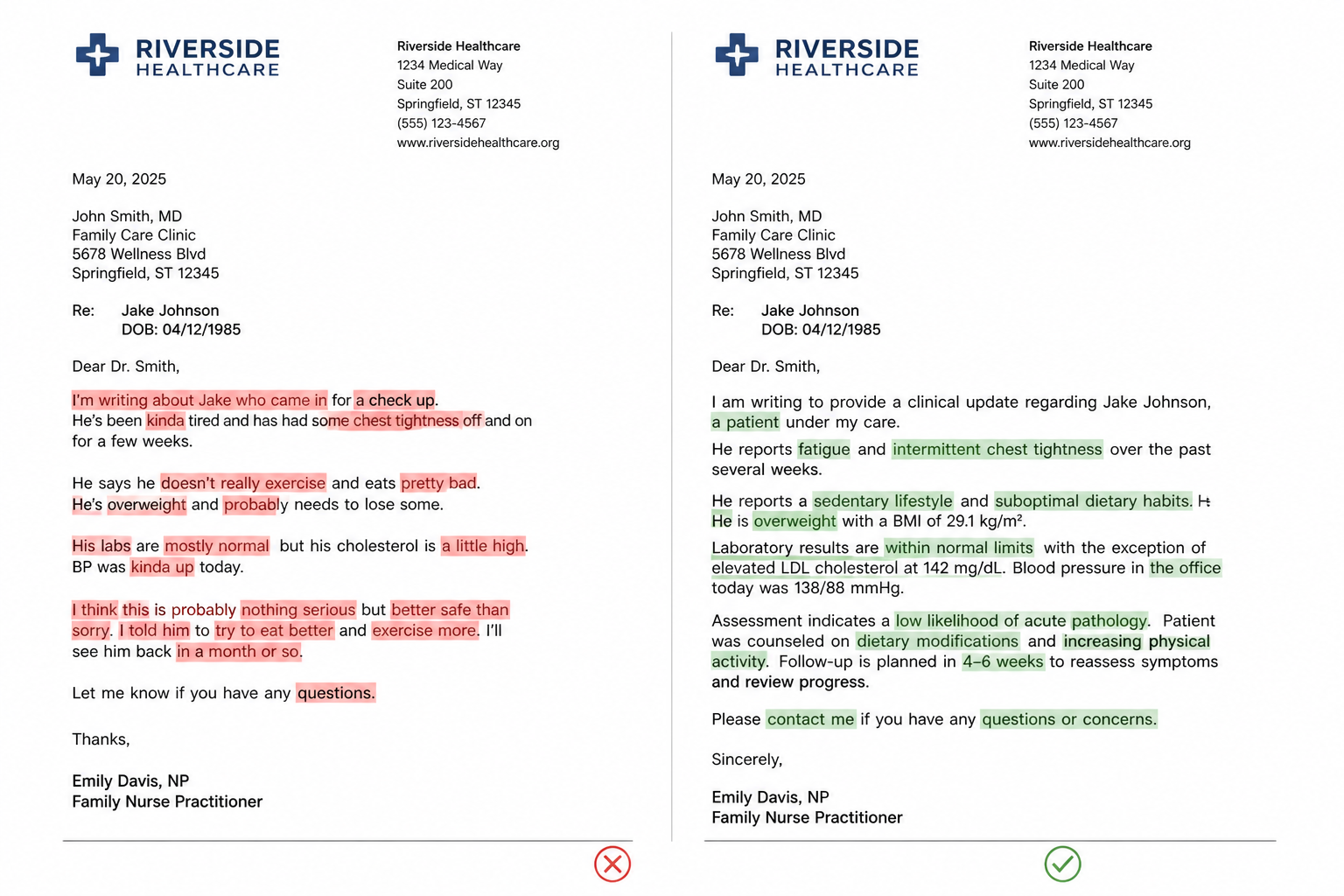
"Kindly Note" and Other Phrases That Cost You OET Writing Register Marks
OET writing "kindly note" and similar dated-formal phrases quietly lower your Genre & Style band. See exactly which phrases to avoid and the professional alternatives examiners expect.
Follow-Up or Follow Up? The Hyphen That Flags a Language Error
OET writing follow up hyphen rule: when 'follow-up' is a hyphenated noun or adjective, when 'follow up' is a two-word verb, and why examiners mark the mix-up under Language.
Discussed WITH the Patient, Not Discussed TO
Discussed with the patient, not discussed to the patient — discuss OET writing follows one fixed preposition rule. Here's why the error happens and how to fix it every time.
Due To vs Because Of: The OET Grammar Trap Almost Everyone Gets Wrong
Due to vs because of in OET writing follows a fixed grammar rule most candidates never learn. Here's the swap test that gets it right every time, worked through real clinical sentences.

Diagnosed WITH vs Diagnosed AS vs Presenting WITH: The Clinical Preposition Traps
Diagnosed with, diagnosed as, and presenting with follow three different rules in OET writing. Here's when each is correct and the preposition errors examiners flag most under Language.
Reported Speech in OET Writing: Say vs Tell, Direct vs Indirect
Reported speech in OET writing means converting what a patient said into indirect speech — the say/tell object rule, the tense backshift, and the pronoun and time changes that go with it.

Clauses of Contrast: Although, Despite, and However in OET Writing
Although, despite, and however in OET writing each need different punctuation and clause structure. Here's the exact rule for each and the Language-criterion errors they cause when swapped.
Parallel Structure: Writing Balanced Sentences in OET Letters
Parallel structure in OET writing: how to match grammatical form across listed symptoms, instructions, and history items so sentences read clean and score well under Language.
Relative Clauses in OET Writing: Who, Which, and That
Relative clauses in OET writing: the defining vs non-defining distinction, correct comma placement, and the who/which/that rule clinical letters require.
Past Simple vs Present Perfect in OET Letters: Getting Patient History Tenses Right
Past simple present perfect oet writing: the exact rule for choosing between them in patient history, and why the wrong tense misreports the clinical timeline.
Passive Voice in OET Writing: When It Helps and When It Hides the Subject
Passive voice oet writing: when the passive is the correct clinical register choice, and when it hides who did what and costs you Content and Clarity marks.
Articles in OET Letters: A, An, The (The #1 Language Error)
OET writing articles a, an, the: the sound-based rule for a/an, when 'the' is required, and the errors in clinical letters that cost Language marks.
Comma Splices and Run-On Sentences in OET Writing
"The results were abnormal, the patient was admitted" is a comma splice. Learn to spot it, fix it, and catch the run-on sentences that hide inside long clinical descriptions.
Subject-Verb Agreement with Medical Nouns: The Dose ... Were Adjusted?
"The dose of the two medications were adjusted" — a Language error that catches candidates in every language group. Learn to find the real subject in long clinical noun phrases.
Prepositions After Clinical Verbs: referred to, commenced on, compliant with
The grammar errors that survive proofreading because the sentence still makes sense. Learn the four collocation groups that cover almost every clinical letter.

Modals and Hedging in OET Letters: Could You Review vs You Must Review
A grammatically perfect sentence can still cost you marks. Learn the politeness ladder that changes with your reader, and how to hedge clinical certainty correctly.

Who Is Actually Reading Your OET Letter? Audience and Register Explained
Your OET letter is scored partly on how well it fits its reader. Learn who the named recipient really is, and how audience changes register, content and tone.

OET Writing Content Selection: Sorting Relevant vs Irrelevant Case Notes
Learn how to select relevant clinical facts and omit irrelevant historical details in OET Writing to satisfy the Conciseness & Clarity criterion.

OET Writing Self-Assessment: How to Mark Your Own Letter
A step-by-step self-assessment checklist and guide to help healthcare candidates evaluate, grade, and improve their OET letters against the official criteria.
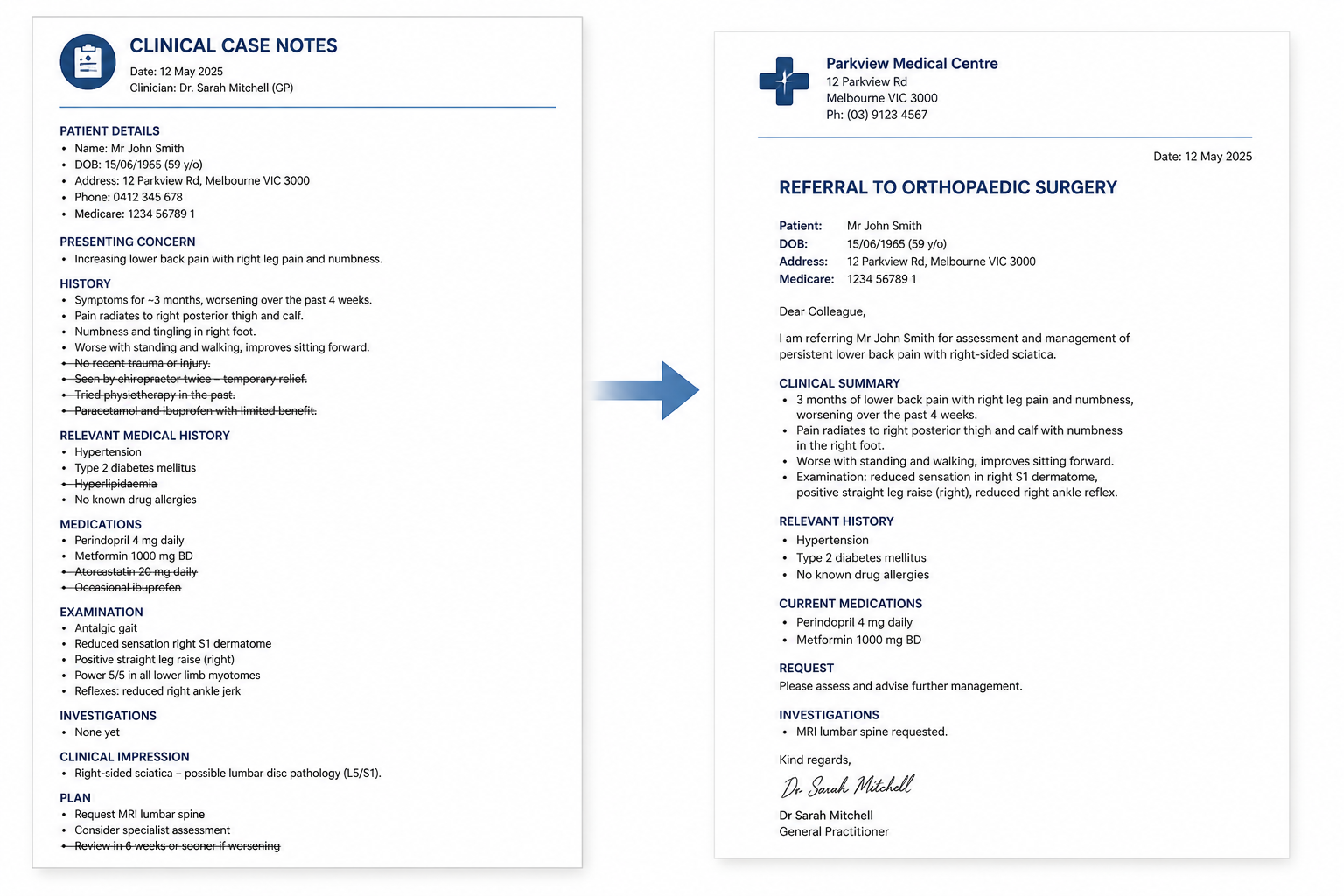
Summarising Information in OET Letters: What to Include, What to Cut
OET letters require selecting the right clinical information from case notes, not transcribing everything. Here is how to decide what stays, what goes, and why the wrong selection fails Content and Conciseness.

OET Writing Band Descriptors: Score Levels Explained
A comprehensive breakdown of the OET Writing band descriptors (0 to 7) for all six assessment criteria, explaining exactly what examiners look for to award a Grade B.
Professional Tone in OET Letters: Genre & Style Explained
How to write in the right professional register for OET letters — the specific language patterns, recipient calibration rules, and common errors that determine your Genre & Style band.
Connectors and Cohesion in OET Writing: Linking Ideas Without Overloading
How to use connectors and cohesion devices in OET letters to improve Organisation and Language marks — without the over-linking that pushes letters into informal register.
Abbreviations in OET Writing: What to Use, What to Avoid, and How to Write Them
Which abbreviations are acceptable in OET letters, how to introduce unfamiliar ones, and the clinical punctuation conventions that differ from everyday English — covering the Language and Conciseness criteria.
Punctuation in OET Writing: What Examiners Mark and What They Miss
Punctuation in OET writing affects Language marks and clinical clarity. This guide covers commas, semicolons, colons, and apostrophes in professional OET letters — with before/after examples from common errors.
Precision in OET Writing: Why Vague Letters Fail and Exact Ones Pass
Precision in OET writing means one clear message per sentence, exact clinical details, and no hedging. This guide shows how examiners spot vague letters and how to write exactly what the recipient needs.
OET Writing Grammar: The 8 Errors That Most Often Cost Language Marks
The 8 grammar errors that most frequently drop OET writing Language bands — with before/after examples from real letter patterns and a checklist for your proofreading pass.

OET Genre and Style: 6 Register Errors That Cost You Marks
The Genre and Style criterion scores your ability to write in the correct clinical register for the specific recipient. These six mistakes appear consistently in exam scripts and each one pulls the score below Band 5.
OET Writing Paragraphing: Why Three Paragraphs Is Not a Rule
How to paragraph an OET letter so it scores well on Organisation and Layout. Covers what examiners actually check, why the three-paragraph formula fails on complex tasks, and how to group clinical information correctly.
OET Grade A vs Grade B: What Actually Separates Them
A criterion-by-criterion comparison of OET Writing Grade A and Grade B against the six OET Writing criteria. What examiners look for, where the gap actually sits.
OET Writing Mistakes That Cost You a Grade B
The ten most common OET Writing mistakes that drop scores from Grade B to Grade C. Each mistake is explained with an example.

5 Things OET Examiners Look for in Letters
What OET markers actually check when reading your letter — the 5 observable patterns that separate Grade B from Grade C across all letter types.

OET Writing Format & Exam Pattern: Complete Test-Day Guide
OET writing sub-test format: 45-minute structure, reading time, case notes, the three letter types, what gets marked, and how the timing breaks down.

OET Writing Band Score: Grade B Path (350+)
What Grade B means in OET writing, how the 6 criteria translate into your score, and the specific errors that keep candidates stuck below 350.
02 · Pillar
Sample Letters & Walkthroughs
Real letters scored at band 350+ with criterion-by-criterion annotation.

OET Transfer Letter: Structure, Content and Common Mistakes
A practical guide to writing an OET transfer letter. Covers how the transfer task differs from a referral and discharge, what information the receiving facility needs, and the marking decisions that affect Content and Organisation scores.

OET Referral Letter: Structure, Language and What Examiners Check
A practical guide to writing an OET referral letter. Covers what information to include, how to select from case notes for a specialist reader, and the specific mistakes that cost Content and Genre marks.

Sample OET Discharge Letter: Band 350 Walkthrough
A full OET discharge letter scored at band 350, with criterion-by-criterion annotation showing exactly where each mark is won or lost.

OET Letter Types Compared: Referral, Discharge, Transfer and Advice
A side-by-side comparison of the four main OET Writing letter types: referral, discharge, transfer, and advice. Purpose, audience, conventions.

OET Advice Letter: How to Write It Well
A practical guide to writing an OET advice letter for nurses and pharmacists, with structure, tone, common mistakes, a register rewrite.

OET Writing Sample Band 350: Annotated Referral Letter
See an oet writing sample band 350 with a full case-notes brief, Grade B model letter, and criterion-by-criterion annotations to help you write with confidence.
03 · Pillar
Registration Pathways
Country-specific routes for nurses, doctors, pharmacists and dentists.

GMC, PLAB and OET: The Real IMG Timeline
The sequencing rules that catch doctors out on the UK IMG pathway — English before PLAB 1, the most-recent-sitting rule, two-year validity windows, and the 2027 location change.

OET for Doctors in Canada: Provincial College Requirements
A detailed guide on how international medical graduates (IMGs) can use OET Medicine for Canadian licensure and residency pathways.

NMC IELTS Requirements 2026 vs OET: Score Comparison
Compare the IELTS and OET score requirements for international nurses registering with the UK NMC, including combining rules and difficulty.

OET for Oman Nurses: UK and Australia Registration in 2026
How nurses based in Oman register with the NMC or AHPRA in 2026. Covers OMSB and MOH licensing, DataFlow verification, OET in the region, and the writing preparation Arabic-speaking nurses need.

OET for Qatar Nurses: UK and Australia Registration in 2026
How nurses based in Qatar register with the NMC or AHPRA in 2026. Covers DHP (QCHP) licensing, the 2026 verification rule, OET in the region, and the writing preparation Arabic-speaking nurses need.

OET for Kuwait Nurses: UK and Australia Registration in 2026
How nurses based in Kuwait register with the NMC or AHPRA in 2026. Covers Kuwait MOH licensing, OET in the region, and the clinical writing preparation Arabic-speaking nurses need for Grade B.

OET for Egyptian Nurses: NMC Registration and UK Pathway (2026)
How Egyptian nurses register with the NMC for UK practice in 2026. Covers the Egyptian Nursing Syndicate, OET in Cairo, and the writing preparation Arabic-medium trained nurses need for Grade B.

OET for Jordanian Nurses: NMC Registration and UK Pathway (2026)
How Jordanian nurses register with the NMC for UK practice in 2026. Covers Jordan Nursing Council credentials, OET in Amman, and the writing preparation that Arabic-trained nurses need for Grade B.

OET for Saudi Nurses: UK and Australia Registration in 2026
How Saudi Arabia-based nurses register with the NMC or AHPRA in 2026. Covers SCHS credentials, OET test centres in Riyadh and Jeddah, and the writing preparation that Arabic-medium trained nurses need most.

OET for UAE Nurses: UK and Australia Pathway Guide (2026)
How nurses based in the UAE register with the NMC or AHPRA in 2026. Covers DHA and DOH credentials, OET test centres in Dubai and Abu Dhabi, and the writing preparation that matters most.

OET for Dentists and the GDC: What the Regulator Accepts in 2026
The 2026 pathway for internationally qualified dentists registering with the GDC in the UK: the English evidence the GDC accepts, ORE Part 1 and Part 2, and where OET fits.

NMC Registration 2026: International Nurses Guide to CBT, OSCE & OET
Step-by-step 2026 NMC pathway for internationally educated nurses: CBT in your home country, OSCE in the UK within 12 weeks, and why OET Writing trips up most applicants.

NMBI Ireland Nurse Pathway in 2026: A Practical Guide
A clear 2026 guide for Filipino, Indian, and Pakistani nurses who want to work in Ireland. This article explains the NMBI registration pathway.

NHS Nurse from Nigeria: 2026 Pathway Guide
A practical 2026 guide for Nigerian nurses and BNSc graduates seeking NHS employment, covering NMC registration, NMCN clearance.

AHPRA Nurse Pathway in 2026: What to Know
A practical 2026 guide to the AHPRA nurse pathway for internationally educated nurses, covering self-checks, ANMAC skills assessment, English requirements.

How to Become NHS Nurse from India in 2026
A practical 2026 guide for Indian nurses on NMC registration, English tests, attestation, timeline, and NHS Band 5 pay.

How to become NHS nurse from Philippines in 2026
A practical 2026 guide for Filipino nurses on NMC registration, OET or IELTS, visa steps, costs, salary, timeline, and common mistakes.
04 · Pillar
Test Prep & Study Plans
Practical study plans, vocabulary, and how to use practice papers well.

Reading Speed for OET Case Notes: A Timed Practice Method
A timed drill to build reading speed for OET case notes without losing accuracy — practical targets, a weekly progression, and why faster reading protects your Content and Conciseness marks.
Self-Editing Your OET Letter: A Line-by-Line Method Before You Submit
Self-editing an OET letter works best sentence by sentence, not as one skim. A four-pass line-by-line method for catching errors a checklist misses before you submit.

OET Listening Part C: The 2 Question Types You Must Tell Apart
Part C gives you one listen, no rewind. Learn to tell detail questions from gist questions before the audio starts — and stop losing marks to recognised-but-wrong options.

OET Reading Part C: Opinion, Fact, or Attitude?
The distinction that decides most Part C marks — what's stated vs what's meant. Learn to spot fact questions and attitude questions before you read the text.

Confidentiality and Patient Identity in OET Letters: What to Include
How to handle patient identifiers, third parties and sensitive details in OET letters — professionally, and without losing Content or Genre & Style marks.

How to Prepare for OET Speaking: Roleplay Practice Strategies
A practical guide on how to prepare for OET Speaking, master the roleplay card structure, and score high in clinical communication criteria.

OET Writing Checklists: A 10-Point Pre-Submission Review
The ultimate 10-point checklist to review spelling, grammar, purpose, and formatting before submitting your OET referral letter.

OET Reading Part A: Tips for Speed and Accuracy
Practical strategies and time-management techniques to pass OET Reading Part A within the strict 15-minute time limit.

Using Technology for OET Writing Preparation: What Helps and What Doesn't
AI tools, grammar checkers, and online resources can support OET writing preparation — but only if used correctly. This guide covers what technology can and cannot do for your OET writing band.

How to Proofread OET Letters: A 4-Minute Checking Routine
A systematic 4-minute proofreading routine for OET writing letters — what to check, in what order, and which errors cost the most marks.

OET Writing for Physiotherapists: Letter Types, Language and Marking Guide
Profession-specific OET writing advice for physiotherapists. Covers the letter types physios are most likely to face, how to use clinical terminology correctly for different recipients, and the marking decisions that affect Content and Genre scores.

How to Write the First Sentence of Your OET Letter
The opening sentence of your OET letter determines your Purpose score. Learn the three-part structure that makes purpose immediately apparent, with examples by letter type and the mistakes that cost candidates marks.
How to Read OET Case Notes: A Fast, Accurate Method
How to read OET writing case notes under exam pressure — what to extract, what to ignore, and how to select information for the recipient so you protect your Content and Conciseness marks in 2026.
OET Writing Time Management: How to Use the 45 Minutes
A minute-by-minute plan for the 45-minute OET writing sub-test — how to spend the 5-minute reading time, how long to plan, and what to cut when you are running behind in 2026.

OET 6-Week Study Plan for Nurses on Shift Work
A realistic 6-week OET Writing study plan for nurses working rotating shifts. Built around 30-45 minute blocks and the Purpose criterion.

OET Writing Vocabulary List: Language Criterion Guide
A practical OET writing vocabulary list for candidates whose Language criterion is weakest, grouped by function and focused on accurate, natural.

OET Past Papers: What Is Available and What Is Not
An honest, practical guide for OET candidates searching for free past papers, including what official materials exist.

OET Preparation 2026: A Practical Starter Guide
A comprehensive, UK English guide for healthcare professionals beginning OET preparation in 2026, with practical advice for returners, test format choices.

OET Study Plan: 4, 8 and 12-Week Templates
A practical OET study plan for healthcare professionals preparing 4 to 12 weeks ahead, with three timelines, weekly hour allocations.

How to Pass OET Writing: Practical First-Time Strategy
A practical OET writing strategy for healthcare professionals aiming for Grade B, with the six criteria, practice plan, and common pitfalls.

How Long Does It Take to Prepare for OET Writing?
Realistic OET preparation timelines by English proficiency level — 4 weeks for C1+, 8–12 for B2, 16+ weeks for B1. How to choose your plan.

OET Writing Retake: How to Pass on Round 2
Structured guide for OET Writing retakers: how to diagnose why you failed, what to change, and how to build a retake plan that produces a different result.
05 · Pillar
Exam Logistics & Results
Booking, retakes, score interpretation, and what to do after the result.

AI vs Human OET Writing Correction: An Honest Comparison
Where AI tools genuinely help with OET Writing preparation, where they fall short on the Purpose criterion.

OET Results in 2026: What Candidates Need to Know
A practical guide to understanding OET results in 2026, including the CBLA candidate portal, the 16-day turnaround, score bands, Grade B, retake planning.

OET exam booking in 2026: a practical guide
Learn how to book the OET exam in 2026, choose the right format, prepare ID, and avoid common booking mistakes.
Or browse by tag
Every topic on the blog
OET Writing Correction
Practise with expert feedback
Submit your OET letters and receive detailed feedback from Dr Mariam's team — assessed against all 6 official writing criteria.