Summarising Information in OET Letters: What to Include, What to Cut
OET letters require selecting the right clinical information from case notes, not transcribing everything. Here is how to decide what stays, what goes, and why the wrong selection fails Content and Conciseness.
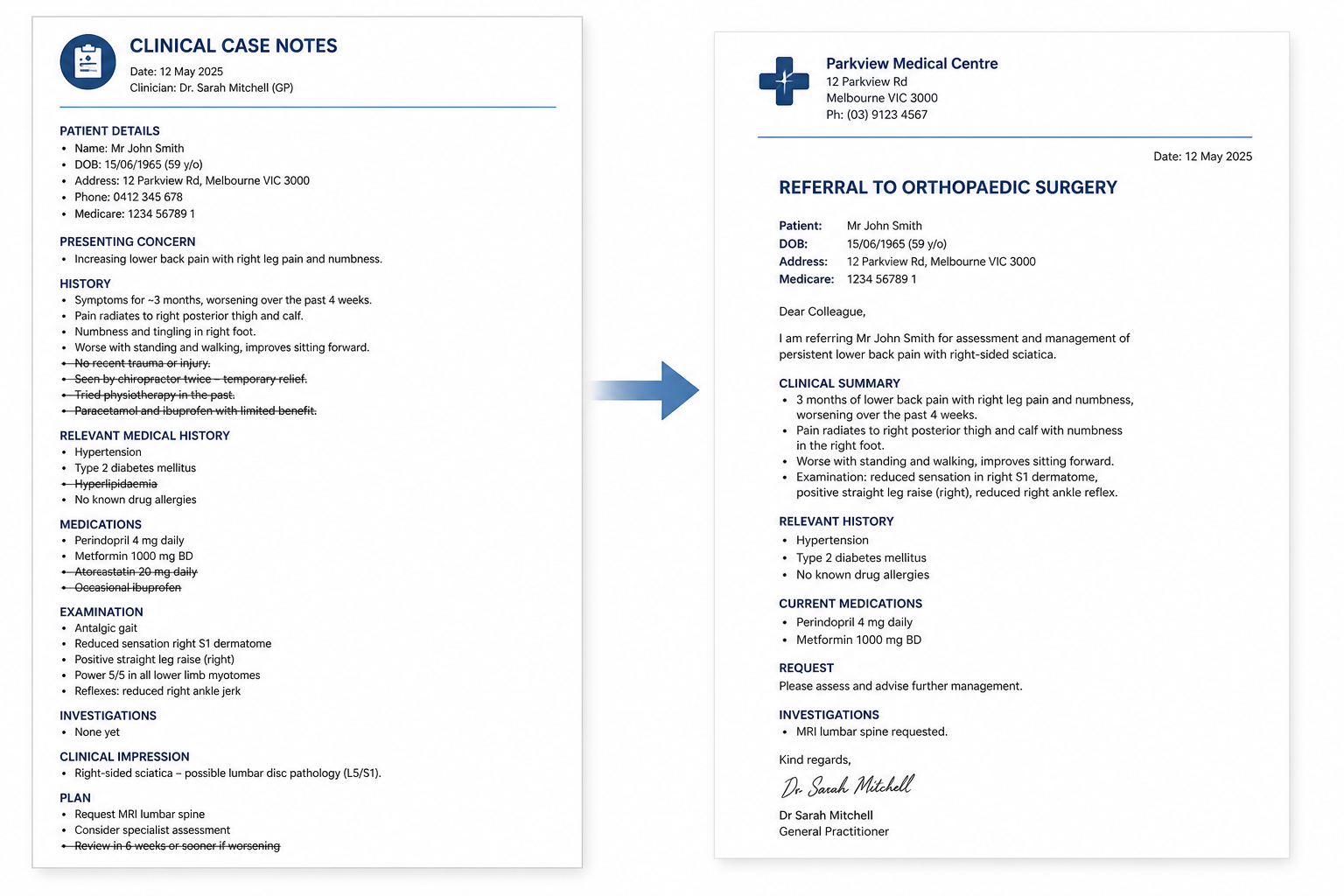
I have marked more than 11,000 OET letters over 20 years. The single most consistent error across every profession and every exam sitting is this: candidates transcribe the case notes rather than summarise them. The letter is two pages long and contains every fact from the case notes. It scores a C on Content. Most candidates can write. Most candidates cannot select.
Why this is a selection skill, not a writing skill
The case notes in an OET task typically contain 40-60% more information than any letter needs. That gap is there by design. Examiners are testing whether you can read clinical information through the recipient’s eyes and decide what they actually need.
The six OET writing criteria (Purpose, Content, Conciseness & Clarity, Genre & Style, Organisation & Layout, Language) include Content and Conciseness as separate bands, and they fail separately. Content has two parts: have you included all information the recipient needs, and have you excluded information they do not need? Failing the second part costs marks just as the first does. Most candidates know they need to include the right things. Fewer know they also lose marks for including the wrong ones.
Conciseness & Clarity does not reward brevity either. It rewards non-redundancy. A long letter can score well on Conciseness if every sentence carries information the recipient needs and no finding appears twice.
The two questions that govern every selection decision
For each item in the case notes, ask two questions. First: does the recipient need this to do what I am asking them to do? Second: would leaving this out change what they decide or do? If the answer to both is no, cut it.
A GP referring a patient to a cardiologist does not need to tell the cardiologist which ward the patient was admitted to, what time they arrived, or which nurse completed the initial observations. None of that information changes whether the cardiologist sees the patient or how they assess them. Ward numbers, admission times, and attending staff almost never survive either question. Current medications, documented allergies, and the specific clinical question always do.
What to include vs exclude in practice
The table below applies this test to a GP-to-cardiologist referral. The case notes contain ten items; six belong in the letter.
| Case note item | Include? | Reason |
|---|---|---|
| Exertional chest pain, onset 3 weeks ago | Yes | This is the reason for referral; the letter has no purpose without it |
| 58-year-old male; BMI 30; ex-smoker, 20 pack-years, quit 2019 | Yes | Cardiac risk profile informs the cardiologist’s assessment and investigation choices |
| Known hypertension; on amlodipine 10mg daily | Yes | Active comorbidity and current medication; affects any new prescribing or intervention |
| Documented penicillin allergy (anaphylaxis) | Yes | Changes prescribing decisions if a procedure or treatment follows the consultation |
| Resting ECG: normal sinus rhythm, no ST changes | Yes | Baseline findings change management; cardiologist interprets these against the patient’s symptoms |
| Father had myocardial infarction aged 62 | Yes | Premature family cardiac history is a risk factor; affects how urgently the cardiologist acts |
| Admitted to Ward 7, Bed 22, at 09:15 on 14 June | No | Administrative detail; the cardiologist does not need this to see or treat the patient |
| Patient described pain as “tightening”, rated 6/10 | No (redundant) | Exertional chest pain already stated; the subjective rating does not change clinical management |
| Long-standing hay fever; on loratadine as needed | No | Unrelated to the cardiac presentation; does not affect the cardiologist’s assessment or plan |
| Attends practice every 6 months for routine chronic disease review | No | Administrative pattern; does not affect the cardiologist’s decision to act on this referral |
The four cut items cover two administrative details, one redundant descriptor, and one unrelated finding. None of the six retained items could be removed without changing what the cardiologist does or prescribes.
How Content and Conciseness interact
Selecting correctly and expressing concisely are two separate skills. A letter that retains the right items but repeats the presenting complaint in the opening sentence and again in the body will drop on Conciseness. A letter that is clean and non-repetitive will still fail Content if the specific clinical question is missing or if the allergy was cut by mistake.
The most common combined failure looks like this: a candidate includes too much (fails Conciseness), writes fast to cover everything, and then leaves out the actual request to the recipient (fails Purpose and Content at the same time). Cutting aggressively enough to write clearly creates room to state the clinical question. Candidates who transcribe never have that room.
Synthesising rather than listing
Most candidates who understand the selection principle then list the remaining facts as separate sentences. “The patient has hypertension. He is on amlodipine 10mg. He developed a dry cough three weeks after commencing the medication.” That is not a summary. It is a list.
A summary integrates: “This patient developed a dry cough three weeks after commencing amlodipine 10mg for hypertension.” One sentence, same clinical content, no information lost. Listing is the default when candidates are uncertain. Each fact gets its own sentence because that feels complete and safe. A letter built from short, disconnected sentences also fails Genre & Style: clinical correspondence integrates information rather than itemises it. The examiner is checking whether you write the way a clinician would. The Case Note Generator produces practice case notes specifically for working on this integration skill.
Checking your own selection
Read back through any practice letter and mark every item you included. For each one, apply the two questions: does the recipient need this to act, and would cutting it change what they do? If you cannot answer yes to at least one, the item does not belong.
The free Writing Checker can flag redundancy in your draft. For written feedback on your selection decisions specifically, a correction from our OET writing correction service gives you the line-by-line annotation that shows exactly which items should have been cut and why the ones you kept were correct or wrong.
Frequently asked questions
Common questions on this topic — full answers below.
How do I know what to include in an OET letter?
What is the difference between Content and Conciseness & Clarity in OET writing?
Can I lose marks for including too much information in an OET letter?
Should I include the patient's past medical history in every OET letter?
How much of the case notes will I use in my OET letter?
What does synthesising mean in OET writing?
OET Writing Correction
Get expert OET letter feedback from Dr Mariam's team
Submit your practice letters and receive a detailed annotated PDF — assessed against all 6 OET writing criteria.
11,000+ letters corrected since 2014 · 4.9★ from 1,900+ reviews