Who Is Actually Reading Your OET Letter? Audience and Register Explained
Your OET letter is scored partly on how well it fits its reader. Learn who the named recipient really is, and how audience changes register, content and tone.
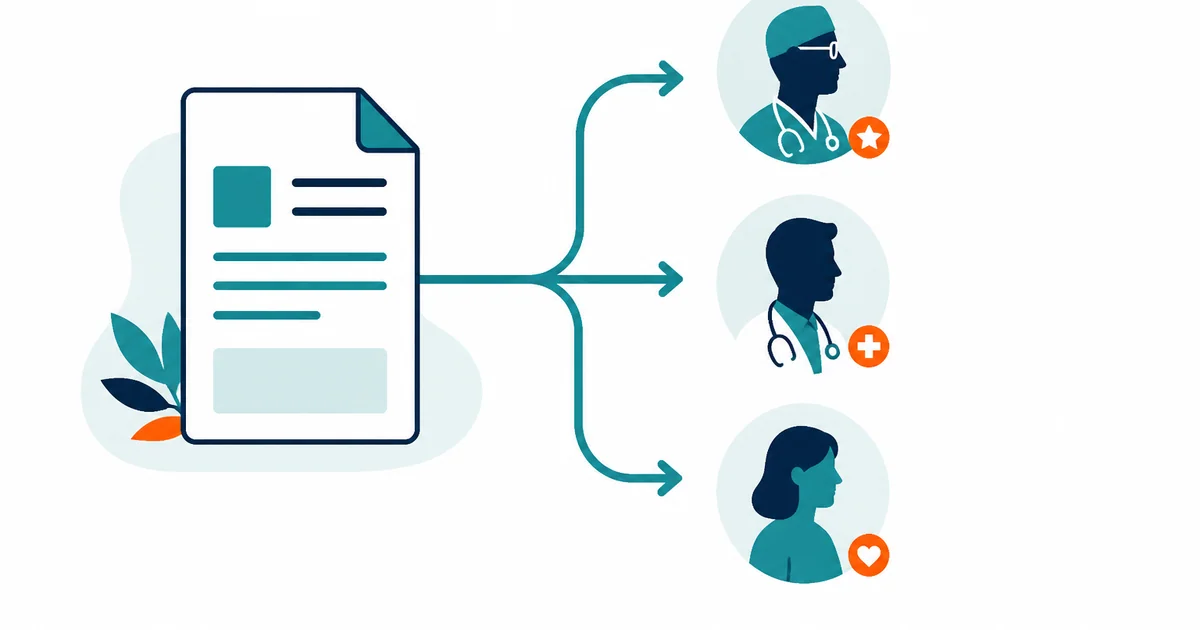
Most candidates prepare for OET Writing by studying letter structure and grammar. Both matter — but there is a question that decides more marks than either, and it is asked before you write a single word: who is going to read this letter?
Every OET task names a recipient. That name is not decoration. Two of the six criteria — Genre & Style and Content — are scored directly against how well your letter fits that specific reader.
The reader determines the register
Register is the level of formality and technicality in your language. In clinical correspondence it is not one fixed “formal” setting — it moves with the reader.
| Reader | Register | Terminology | Typical letter |
|---|---|---|---|
| Specialist (e.g. cardiologist) | Professional, peer-to-peer | Full clinical terminology | Referral |
| GP | Professional | Clinical, with context | Discharge, referral |
| Community nurse / allied health | Professional, practical | Clinical, care-focused | Transfer, discharge |
| Patient or carer | Warm, clear, direct | Plain language only | Advice |
Writing to a cardiologist that the patient “has a heart problem” reads as vague. Writing to a patient that they have “paroxysmal atrial fibrillation” without explanation reads as thoughtless. Neither sentence is grammatically wrong — both lose marks, because register is scored against the reader.
The reader determines the content
The 2026 marking approach weights clinical relevance heavily: Content is not about including everything, it is about selecting what this reader needs in order to act.
Ask two questions before selecting from the case notes:
- What does this reader already know? A specialist who has treated the patient before does not need the full history repeated. A brand-new provider needs the essentials from zero.
- What will this reader do next? A GP reviewing in seven days needs the medication changes and monitoring plan. A physiotherapist needs mobility status, not the antibiotic course.
Information the reader cannot act on is padding — and padding is exactly what the Conciseness & Clarity criterion penalises.
The reader determines the requests
A request to a senior colleague is phrased as a request: “I would be grateful if you could review her medication.” An instruction to a patient is warm but direct: “Please take one tablet each morning with food.” Reversing those two registers — ordering a consultant about, or hedging vague suggestions at a patient — is one of the most common Genre & Style errors we see across 11,000+ corrected letters.
A 30-second pre-writing routine
Before you plan the letter, answer three questions from the task instructions:
- Who is the named reader, and what is their role?
- What do they already know about this patient?
- What must they do after reading?
Every selection and phrasing decision afterwards becomes easier, because you are writing to someone instead of writing about a patient.
Where to go next
Audience awareness sits at the centre of the OET writing criteria — particularly Genre & Style. For the full picture of how each criterion is scored, start there.
And because your own register is genuinely hard to judge from inside your own writing, an expert review helps: our OET writing correction service marks your letter against all six criteria and tells you exactly where the tone slips for its intended reader.
Frequently asked questions
Common questions on this topic — full answers below.
Does the reader of the letter affect my OET score?
Should I use medical terminology in every OET letter?
Who are the most common OET letter recipients?
How do I decide what the reader already knows?
OET Writing Correction
Get expert OET letter feedback from Dr Mariam's team
Submit your practice letters and receive a detailed annotated PDF — assessed against all 6 OET writing criteria.
11,000+ letters corrected since 2014 · 4.9★ from 1,900+ reviews