"Kindly Note" and Other Phrases That Cost You OET Writing Register Marks
OET writing "kindly note" and similar dated-formal phrases quietly lower your Genre & Style band. See exactly which phrases to avoid and the professional alternatives examiners expect.
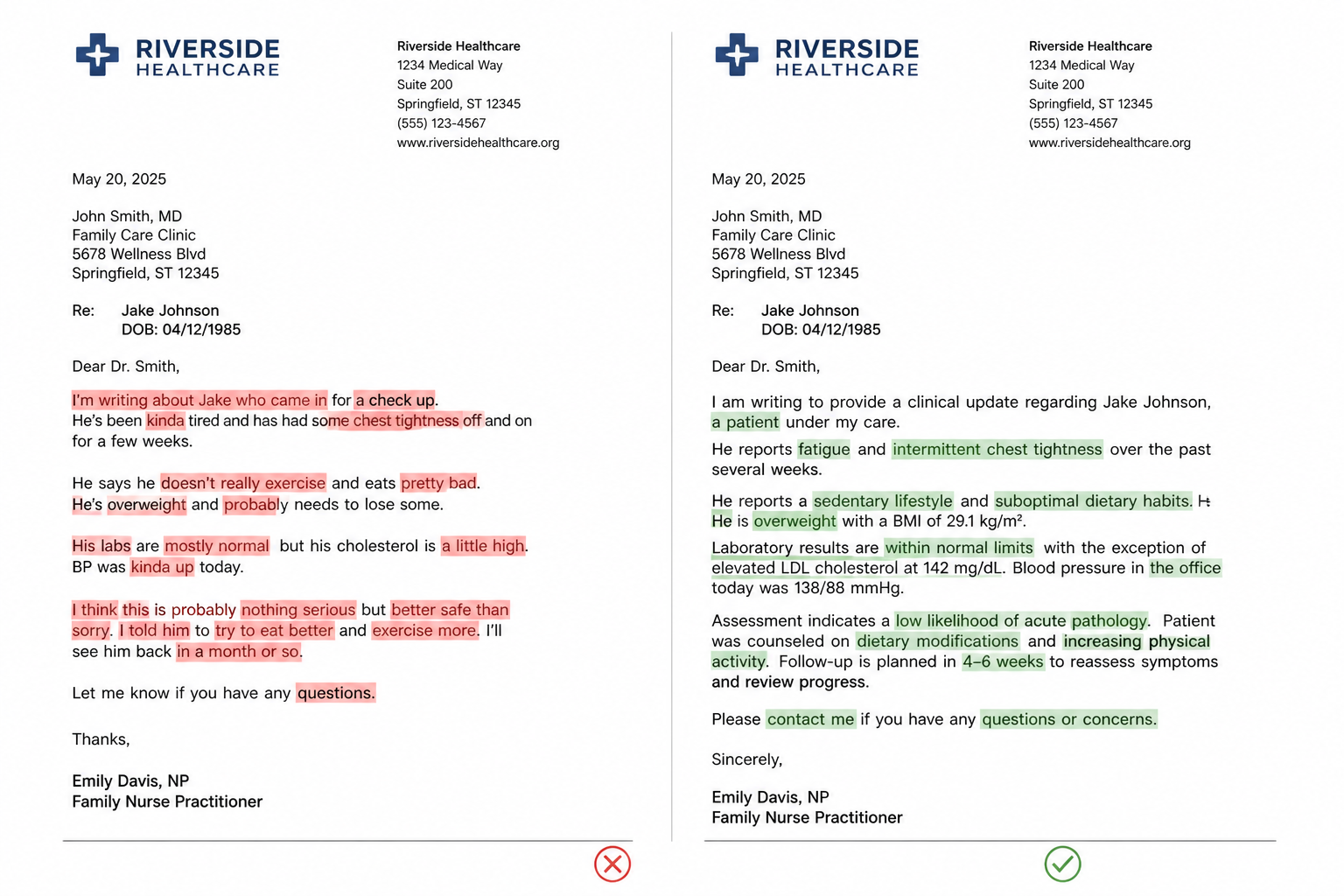
“Kindly note that the patient’s INR was elevated on admission.” Every word in that sentence is spelled correctly and the grammar is clean. It will still cost marks in OET writing, because “kindly note” is not the register a clinician uses when writing to a colleague. It is the register of a government circular or a formal notice board, and examiners marking Genre & Style recognise the mismatch the moment they read it.
In short
“Kindly note” is a dated, ceremonial-correspondence phrase that reads as the wrong register in OET writing, even though it is grammatically correct. Clinical letters use plain, direct language: “please note” or simply stating the fact without a lead-in phrase at all. The same problem applies to a family of similar phrases — “please be informed that,” “do the needful,” “revert back,” “please find enclosed herewith,” and “esteemed” — all of which are correct English borrowed from formal business or ceremonial correspondence rather than clinical writing. Because these phrases are grammatically valid, they pass a normal proofread and a grammar checker untouched; only a register-aware read catches them. Under the OET Writing marking scheme, Genre & Style is one of six official criteria (alongside Purpose, Content, Conciseness & Clarity, Organisation & Layout, and Language), and repeated dated-formal phrasing is exactly the kind of pattern that keeps a letter at Grade C+ rather than B. Source: oet.com.
Watch the full breakdown: “Kindly Note” and Other Phrases That Cost You Register Marks works through each phrase with clinical letter examples.
Why does “kindly note” cost you Genre & Style marks in OET writing?
Genre & Style is the OET criterion that checks whether a letter reads as authentic professional correspondence between clinicians, rather than academic prose, casual conversation, or — in this case — formal ceremonial writing borrowed from another context entirely. It sits alongside Purpose, Content, Conciseness & Clarity, Organisation & Layout, and Language as one of the six official criteria examiners mark against.
“Kindly note” fails this test for a specific reason: it is not too casual and it is not too academic. It belongs to a third register altogether — the register of formal notices, circulars, and ceremonial business letters — and none of those match clinical correspondence. A referral letter is direct and functional. It states facts, makes requests, and gives recommendations without dressing them in the language of a formal announcement.
This distinguishes “kindly note” from the broader over-formality problem covered in our professional tone guide, which looks at academic connectors like “furthermore” and apologetic hedging like “sorry to bother you.” “Kindly note” and its relatives are a narrower, more specific category: dated-formal phrases lifted wholesale from bureaucratic correspondence conventions, correct as English but wrong as clinical genre.
The phrase list: correct English, wrong genre
Each phrase below is grammatically valid. Each one is also a genre mismatch that costs Genre & Style marks the moment an examiner spots the pattern.
| Dated-formal phrase | Why it’s the wrong register | Clinical replacement |
|---|---|---|
| ”Kindly note that…” | Ceremonial notice-board phrasing, not clinician-to-clinician language. | ”Please note…” or state the fact directly. |
| ”Please be informed that…” | A formal-announcement opener; adds no meaning to the sentence. | Delete it and start with the fact: “The patient was discharged on…" |
| "Kindly do the needful” | Vague and archaic — it does not say what action is required. | Name the exact action: “Please arrange a follow-up appointment." |
| "At the earliest” | Business-correspondence shorthand, imprecise for a clinical timeframe. | ”As soon as possible” or a specific timeframe: “within one week." |
| "Kindly revert back to me" | "Revert” already means “reply”; “back” is redundant, and the phrase reads as dated office English. | ”Please contact me” or “please reply at your earliest convenience." |
| "Please find enclosed herewith” | Legal/ceremonial letter convention; “herewith” has no place in clinical correspondence. | ”I have enclosed…” or “Attached is…" |
| "Our esteemed colleague / your esteemed self” | Ceremonial flattery, out of place between clinicians. | Drop the adjective entirely: “our colleague,” “you.” |
Notice the pattern across every row: the fix is rarely a more sophisticated phrase. It is a plainer, shorter one. This is the opposite instinct from what many candidates expect — the assumption that a more elaborate phrase signals more respect or more professionalism. In clinical correspondence, the reverse is usually true.
Why do these phrases feel so formal if they’re wrong?
Every phrase in that table is polite, correct, and formal-sounding, which is exactly why candidates reach for them. The instinct to sound respectful and professional in a letter to a doctor, a specialist, or a regulator is the right instinct. The problem is where these particular phrases come from.
“Kindly note,” “do the needful,” and “please find enclosed herewith” are conventions from formal business and ceremonial correspondence — the language of official notices, government circulars, and traditional business letters. That register has its own long, well-established history, and used in the right context, none of it is wrong. It is simply the wrong context. A referral letter between two clinicians is a different genre entirely: direct, functional, and free of ceremonial flourish, even when it is being maximally polite and professional.
This is a genre-transfer error, not a proficiency error. A candidate using “kindly note” almost always has strong command of English grammar and vocabulary — strong enough to produce a fully correct sentence in the wrong genre. That is precisely why it is worth fixing deliberately rather than assuming it will resolve itself as general English improves. The competence is already there; only the target register needs to shift.
Why grammar checkers and spellcheck miss this pattern entirely
“Kindly note that the consultation was rescheduled” will pass every automated grammar check without a single flag. The subject-verb agreement is correct. The article usage is correct. The spelling is correct. There is nothing in the sentence a syntax-based tool is built to catch, because the sentence is not broken — it is simply the wrong genre for its context, and genre is not something spellcheck or a grammar rule engine evaluates.
This is the main reason the pattern survives so many rounds of self-editing. A candidate reads the letter back, checks it against a grammar checklist, runs it through an automated tool, and the phrase remains untouched at every stage, because none of those checks are built to catch a register mismatch. Only a read that is specifically evaluating genre and style — the way an OET examiner reads, or the way a human corrector marking against all six criteria reads — will flag it.
Where this shows up most: letters that request an action
Dated-formal phrases cluster in one specific place — the sentence where a candidate is asking the reader to do something. “Kindly do the needful and arrange a follow-up” and “kindly revert back with your availability” both appear at the exact moment a candidate wants to sound extra polite, because a request can feel like an imposition. The instinct to soften a request with more formal language is reasonable. The specific phrases chosen are not.
Compare these two versions of the same request:
“Kindly do the needful at the earliest and revert back to confirm the appointment.”
“Please arrange the appointment as soon as possible and confirm the date by return.”
Both versions are polite. Both make the same request. The second version says exactly what is needed — arrange, confirm, and by when — while the first hides the actual request behind vague ceremonial language that a busy GP or specialist has to decode. This is also a Content and Clarity issue, not only a Genre & Style one: “do the needful” does not specify what action is required, so a reader has to infer it from context, which is exactly the kind of ambiguity examiners are trained to penalise across multiple criteria at once.
The fix is the same every time: replace the ceremonial lead-in with the specific action verb — arrange, confirm, review, contact — and state the timeframe as a real number of days rather than “at the earliest.”
A 60-second self-check for dated-formal phrases
Because these phrases are invisible to grammar tools, check for them manually with a short, targeted pass:
- Search your letter for “kindly.” If it appears anywhere except a genuine expression of gratitude (“thank you kindly” is rare in clinical writing too), replace or delete it.
- Search for “needful,” “herewith,” “esteemed,” and “revert.” These four words almost never belong in a referral or discharge letter. If you find one, rewrite the sentence without it.
- Read your opening and closing lines specifically. Ceremonial phrases cluster at the start and end of letters — “please be informed that” as an opener, “kindly do the needful” as a closer — because that is where candidates feel the most pressure to sound formal.
- Ask whether a plainer version says exactly the same thing. If “please note the patient’s allergy” carries the same information as “kindly note that the patient has an allergy,” the plainer version is always the correct choice in clinical register.
This check takes under a minute once you know the specific words to search for, and it catches a category of error that a standard proofreading pass consistently misses. For the broader set of Language-criterion errors that often appear alongside register slips, our grammar tips guide covers the eight most frequent mistakes, and our Genre & Style criterion breakdown explains exactly how the 0–7 band is assigned. For a broader look at over-formal and under-formal register mistakes beyond this specific phrase family, see our Genre and Style mistakes guide.
The honest limit of self-editing for register
Register errors like “kindly note” are hard to self-correct because the sentence never sounds wrong to the person who wrote it — these phrases sound formal and respectful precisely because that is what they were designed to do in their original context. The mismatch is only visible from the outside, reading the letter as a clinician would read a colleague’s correspondence rather than as the writer who already knows what they meant to convey.
The free Writing Checker is a useful first pass for surface issues, but register patterns like this one are exactly what a full criterion-by-criterion review is built to catch. Our OET writing correction service reviews your actual letter against all six official criteria, including the dated-formal phrasing that reads as polite to the writer and as a Genre & Style flag to the examiner.
Frequently asked questions
Common questions on this topic — full answers below.
Is 'kindly note' wrong in OET writing?
Why does 'kindly note' lower my Genre & Style band if it's grammatically correct?
What should I write instead of 'kindly note'?
What are other dated-formal phrases to avoid in OET letters?
Why do grammar checkers not catch these phrases?
OET Writing Correction
Get expert OET letter feedback from Dr Mariam's team
Submit your practice letters and receive a detailed annotated PDF — assessed against all 6 OET writing criteria.
11,000+ letters corrected since 2014 · 4.9★ from 1,900+ reviews