Scoring Cluster · 6 Criteria · 2026
OET Writing Band Descriptors: What Each Score Level Means Per Criterion
Every score from 0 to 7 has a published descriptor. Knowing what separates a 5 from a 6 in Content, or a 2 from a 3 in Purpose, is the difference between preparing and hoping.
In short
- •OET writing has six criteria. Five are scored 0–7; Purpose is scored 0–3. Each level has a published CBLA descriptor.
- •Grade B (350+) requires Purpose ≥ 2/3 and all other criteria ≥ 5/7. One criterion at 4/7 usually drops you below 350.
- •The most misread descriptors are Conciseness (candidates confuse "brief" with "incomplete") and Content (more detail is not always a higher score).
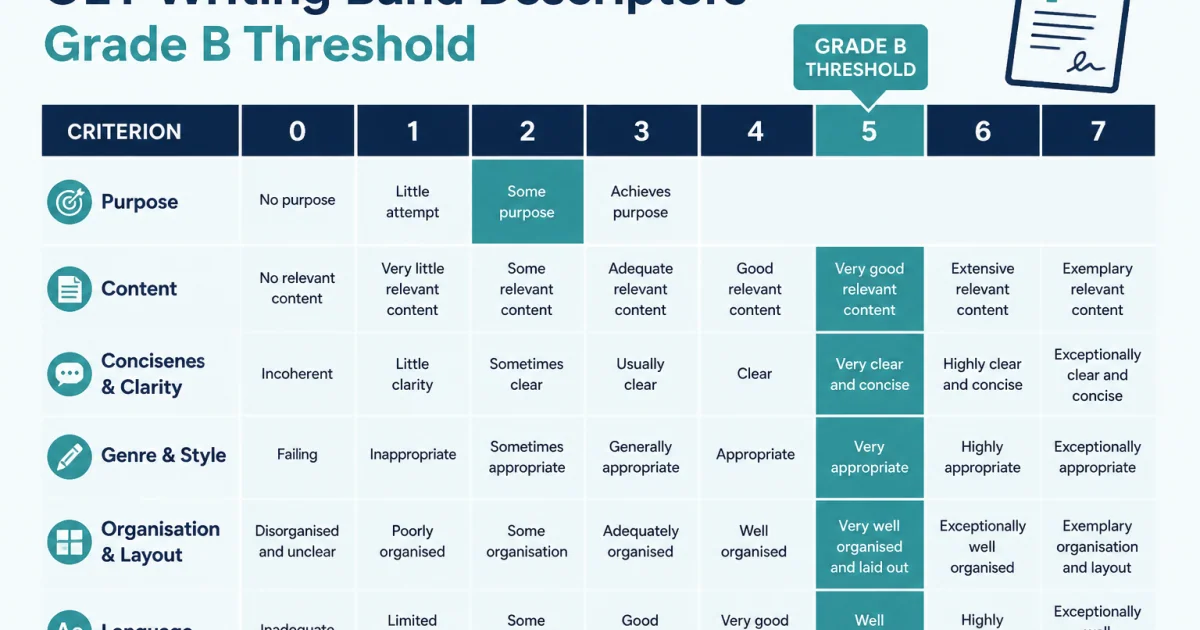
What Are Band Descriptors?
CBLA (Cambridge Boxhill Language Assessment, the organisation that owns OET) publishes a document called the OET Writing Assessment Criteria and Level Descriptors. For each criterion, this document defines exactly what a candidate's letter must demonstrate to earn each score on that criterion's scale.
Examiners do not score impressionistically. They read your letter, locate observable features in the text, and match those features to the descriptor that best fits. A 5/7 in Content does not mean "pretty good" — it means your letter meets specific, published criteria for that score level.
This matters for preparation: once you know what the 5 descriptor requires, you can check your own letters against it. Many candidates improve from Grade C to Grade B by addressing the descriptor gap they were unaware of.
How Band Descriptors Translate to Your 0–500 Score
The OET writing sub-test converts six criterion scores to a 0–500 scale. Two trained assessors independently score your letter; their scores are reconciled and converted using CBLA's published formula.
Grade B requires 350+. In practice, this means:
| Criterion | Scale | Min Score for Grade B | Descriptor at That Level |
|---|---|---|---|
| Purpose | 0–3 | 2 / 3 | Purpose mostly clear, stated in opening paragraph, minor lapses only |
| Content | 0–7 | 5 / 7 | Relevant information selected; minor omissions or one unnecessary detail |
| Conciseness & Clarity | 0–7 | 5 / 7 | Effective summarisation; minor redundancy does not impede reading |
| Genre & Style | 0–7 | 5 / 7 | Appropriate professional register, mostly formal tone, minor lapses |
| Organisation & Layout | 0–7 | 5 / 7 | Logical paragraph structure, mostly clear sequencing, minor layout issues |
| Language | 0–7 | 5 / 7 | Mostly accurate grammar and vocabulary; errors rarely impede meaning |
Purpose Criterion Descriptors (0–3 Scale)
Purpose is the only criterion using a 0–3 scale because it measures a single quality: whether the letter's reason for writing is clear, immediate, and maintained. A delayed or vague purpose limits the scores possible in Content and Organisation too.
| Score | Descriptor Summary | What It Looks Like |
|---|---|---|
| 3 | Purpose immediately apparent and sufficiently developed | Sentence 1 states letter type (referral/discharge/advice), recipient role, and required action |
| 2 | Purpose apparent but not sufficiently highlighted or developed | Purpose stated in first paragraph but not sentence 1, or recipient action only implied |
| 1 | Purpose not immediately apparent; may show very limited expansion | Purpose buried in paragraph 2 or later, or implied but never directly stated |
| 0 | Purpose partially obscured, unclear, or misunderstood | Letter reads as copied case notes; no reason for writing stated at any point |
Content Criterion Descriptors (0–7 Scale)
Content is not about quantity. A letter that includes every detail from the case notes does not score higher than one that selects only what the recipient needs to act. The descriptor measures relevance, accuracy, and prioritisation.
| Score | Descriptor Summary | Common Feature at This Level |
|---|---|---|
| 7 | All relevant information included and prioritised; no unnecessary detail | Every clinical fact serves the stated purpose; nothing irrelevant included |
| 6 | Almost all relevant information present; very minor omissions or inclusions | One small gap or one minor irrelevant detail; recipient can still act fully |
| 5 | Most relevant information present; minor omissions or one unnecessary inclusion | One missing clinical detail or one repeated piece of background; still functional |
| 4 | Some relevant information present; noticeable omissions or unnecessary detail | Two or more content gaps; or significant case note copying inflating word count |
| 3 | Limited relevant information; important details missing | Key management actions absent; recipient cannot act without additional sources |
| 2 | Very little relevant information; mostly irrelevant or inaccurate | Broad paraphrasing of case notes with little clinical selection |
| 1 | Minimal or no relevant information | Letter contains almost no clinically useful content |
| 0 | No relevant content at all | Incomprehensible or empty of clinical meaning |
Conciseness & Clarity Criterion Descriptors
The most misunderstood criterion. Candidates read "concise" and cut content that should be in the letter. The descriptor is not about brevity; it is about absence of redundancy. A letter with 220 words can score 7/7 in Conciseness if every sentence earns its place.
Common errors at the 4/7 level: copying the opening of case notes as an introductory paragraph, restating the diagnosis in every paragraph, and including social history when the letter is about acute management.
| Score | Descriptor | Typical Candidate Letter |
|---|---|---|
| 7 | No redundancy; every sentence necessary | No repeated information; no padding; letter reads like a professional referral |
| 6 | Minor redundancy only; does not impede reading | One sentence could be cut; reader still receives a clean, efficient letter |
| 5 | Some redundancy; slightly verbose but still readable | Introductory recap of diagnosis already stated in purpose; one repeated medication name |
| 4 | Noticeable redundancy; distracts from key information | Opening paragraph restates case notes; diagnosis mentioned three times across the letter |
| 3 | Significant redundancy; key points hard to locate | Half the letter is case note reproduction; purpose statement is buried |
| 2 | Excessive repetition; clarity seriously impaired | Same information repeated across multiple paragraphs; recipient cannot identify the action needed |
| 1–0 | Incoherent or completely redundant | No discernible attempt to summarise; raw case notes copied verbatim |
Language Criterion Descriptors
Language scores are often the most practised and the least useful to over-focus on. Examiners weight meaning-changing errors far more than minor grammar slips. A sentence with a missing article loses far less than a sentence where the wrong preposition changes a clinical instruction.
| Score | Descriptor | Error Profile |
|---|---|---|
| 7 | No errors; full command of clinical and professional language | Zero errors. Rare even for native English speakers |
| 6 | Very few minor errors; no impact on communication | 1–2 article or preposition slips; no meaning-changing errors |
| 5 | Some errors; mostly minor; meaning clear throughout | 3–5 minor errors; possibly one borderline error; recipient still understands fully |
| 4 | Noticeable errors; some impede meaning | 1–2 meaning-changing errors (wrong drug dose phrasing, wrong clinical verb) |
| 3 | Frequent errors; communication often impeded | Multiple unclear sentences; recipient must infer intended meaning |
| 2–0 | Errors dominate; communication seriously impaired | Sentence-level breakdown; clinical instructions uninterpretable |
Using Band Descriptors to Self-Assess Your Letters
Most candidates guess their score after writing a practice letter. A descriptor-based review takes longer but produces actionable feedback you can act on in your next letter.
- 1
Score Purpose first
Read your opening sentence. Does it state the letter type, the recipient's role, and the required action? If not, score 1 or 2 — not 3.
- 2
Check Content against the recipient, not the case notes
For each paragraph, ask: 'Does the recipient need this to do what I'm asking?' If not, it does not belong in a high-scoring letter.
- 3
Count redundant sentences for Conciseness
Highlight every sentence that repeats information already given. Each one is evidence for a lower Conciseness score.
- 4
Read for register in Genre & Style
Read your letter aloud. Any phrase that sounds like speech rather than professional correspondence is a Genre & Style flag.
- 5
Check Language for meaning-changing errors only first
Underline any sentence where the clinical meaning could be misread. Those are the errors that affect your score most.
After scoring yourself, compare your self-assessed profile to the Grade B threshold table above. The criterion furthest below threshold is where to focus next. For a full framework, see the OET writing self-assessment guide.
Related guides in this cluster
- OET Writing Criteria — all 6 explainedOverview
- What OET examiners look forHow examiners read at each descriptor level
- OET writing self-assessment guideUse these descriptors to mark your own practice letters
- How OET writing is scored (0–500 explained)
Frequently asked questions
Where can I find the official OET band descriptor document?
CBLA publishes the OET Writing Assessment Criteria and Level Descriptors PDF on oet.com. Search for 'OET writing level descriptors' on the official site. This page summarises and explains those descriptors with practical examples.
What is the difference between a 5 and a 6 in OET writing Content?
A Content score of 5/7 means relevant information is selected but there are minor omissions or one unnecessary detail. A score of 6/7 means almost all relevant information is present and prioritised, with only very minor gaps. The gap between 5 and 6 is usually one missed clinical detail or one small irrelevant inclusion.
Why does Purpose only go to 3 when all other criteria go to 7?
Purpose has a narrower range because it measures a single, binary quality: whether the letter's reason for writing is clear and immediately stated. CBLA uses a 0–3 scale to reflect three distinct states: absent (0), present but unclear or delayed (1–2), and clear and maintained (3).
Can I achieve Grade B with a 4/7 on one criterion?
Rarely. Grade B (350+) typically requires no criterion below 5/7. A 4/7 on Content or Language combined with strong scores elsewhere can still produce around 330–340, which falls short of 350. The scoring model does not allow high scores in one area to fully compensate for a low score in another.
How often do examiners award 7/7 in Language?
Rarely for non-native speakers. A 7/7 in Language means no grammatical, lexical, or punctuation errors that affect communication. Most Grade A candidates score 6/7 in Language. A 6/7 is excellent and more than sufficient for Grade B.
What does the Conciseness descriptor mean by 'effective summarisation'?
Effective summarisation at the 5–7 descriptor level means converting case note details into purpose-driven prose without copying text verbatim, without repeating information across paragraphs, and without including background data the recipient does not need.
See exactly where you are on each descriptor
Dr Mariam's team scores your letter against every criterion with descriptor-level commentary — so you know not just your grade, but precisely what moved you from a 4 to a 5, or a 5 to a 6.
Get examiner-level feedback — from $12