Application Cluster · 24-Point Checklist · 2026
How to Self-Assess Your OET Writing: A Criterion-by-Criterion Marking Guide
Most candidates guess their score after writing a practice letter. A descriptor-based self-assessment takes 15 minutes and tells you exactly which criterion to fix next.
In short
- •Self-assessment against OET's six criteria works — but only if you use the published band descriptors, not your own impression of the letter.
- •The reliable assessment order: Purpose first, then Content, Organisation, Conciseness, Genre & Style, Language. This matches the impact order on your final score.
- •Candidates consistently overmark Content and undermark Conciseness. The 24-point checklist below corrects for both.
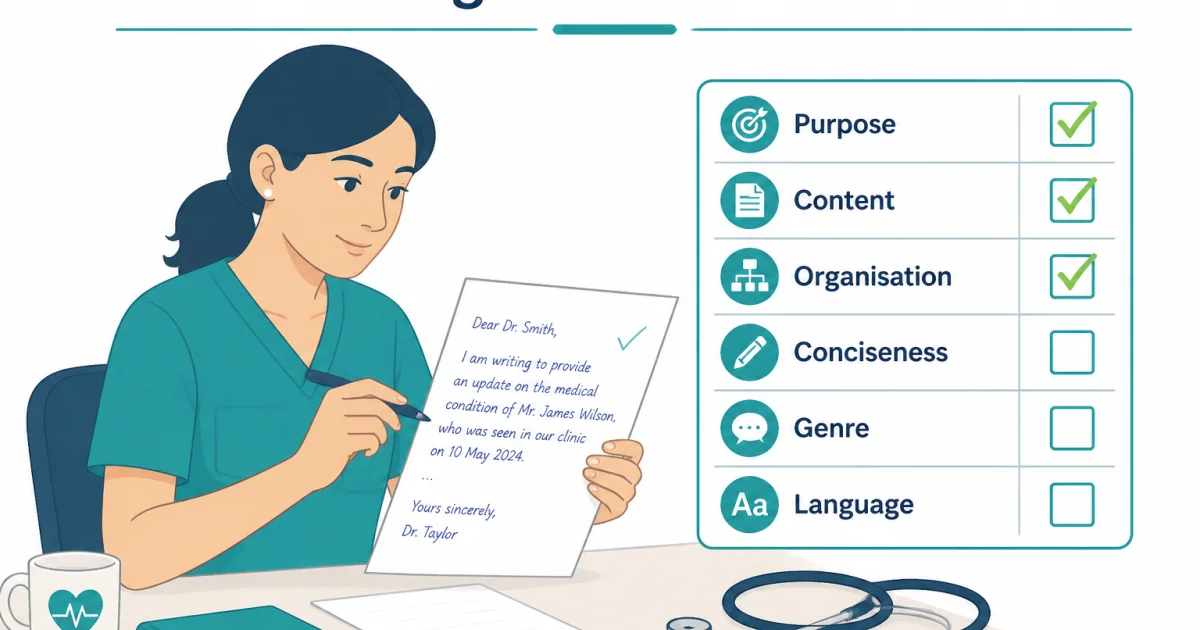
Why Self-Assessment Is Hard (and When It Works)
Reading your own writing as an examiner does requires two things most candidates do not have: distance from the text, and a clear benchmark for each score level. Without those, self-assessment is just re-reading your letter and deciding it is better than last time.
The distance problem is real. You know what you meant to write. An examiner only knows what is on the page. When you read your Purpose statement and think it is clear, you are partly reading your intention — not the text. The same is true for Content: you know which details matter clinically, so you read them into the letter even when they are absent.
The checklist below is designed to replace impressionistic reading with observable checks. Each question has a yes/no answer based on what is on the page, not what you intended.
What You Need Before You Start
- →
CBLA band descriptor document
Available from oet.com. Search 'OET writing level descriptors.' Print the criterion descriptions for Purpose through Language before you self-assess.
- →
Graded sample letters
CBLA publishes sample letters with commentary. Download at least one Grade B and one Grade C letter for your profession before you self-assess your first letter.
- →
Physical distance from your draft
Write your letter, then wait at least 30 minutes before assessing it. Reading the letter immediately makes the intention problem worse.
- →
The 24-point checklist below
Work through each criterion in order. Do not skip ahead or assess all criteria at once — the order matters because Purpose affects how all other criteria are read.
The 24-Point Self-Assessment Checklist
Answer each question with yes or no based only on what is written. For a 20+ total, your letter is likely at Grade B. Below 16, identify which criterion cluster has the most no answers — that is your next focus area.
| # | Criterion | Question | Score |
|---|---|---|---|
| 1 | Purpose | Does sentence 1 or 2 state the letter type (referral/discharge/advice)? | +1 if yes |
| 2 | Purpose | Is the recipient's role and required action clear from the opening paragraph? | +1 if yes |
| 3 | Purpose | Is the purpose maintained throughout — not buried, not repeated, not contradicted? | +1 if yes |
| 4 | Purpose | Does the letter have one clear purpose (not two competing purposes)? | +1 if yes |
| 5 | Content | Is every included clinical detail relevant to the recipient's role? | +1 if yes |
| 6 | Content | Are the key management actions or care requirements stated? | +1 if yes |
| 7 | Content | Is critical information absent? (answer 'no' = +1 for you) | +1 if NO |
| 8 | Content | Is important clinical information prioritised, not buried in the middle? | +1 if yes |
| 9 | Organisation | Does each body paragraph have one clear topic or focus? | +1 if yes |
| 10 | Organisation | Does the introduction establish context before clinical detail? | +1 if yes |
| 11 | Organisation | Does the closing paragraph contain only the requested action? | +1 if yes |
| 12 | Organisation | Does information follow a logical sequence the recipient can follow? | +1 if yes |
| 13 | Conciseness | Does the letter open with an original purpose sentence (not a case note copy)? | +1 if yes |
| 14 | Conciseness | Is the diagnosis mentioned only once (or as clinically necessary)? | +1 if yes |
| 15 | Conciseness | Are there fewer than 2 sentences that repeat information from an earlier paragraph? | +1 if yes |
| 16 | Conciseness | Does every sentence add information not already given? | +1 if yes |
| 17 | Genre & Style | Does the letter use a correct formal salutation (Dear + role/name)? | +1 if yes |
| 18 | Genre & Style | Is the language throughout formal (no colloquial phrases)? | +1 if yes |
| 19 | Genre & Style | Does the closing formula match professional correspondence (Yours sincerely / faithfully)? | +1 if yes |
| 20 | Genre & Style | Is the profession-specific register appropriate (nurse tone, doctor tone, pharmacist tone)? | +1 if yes |
| 21 | Language | Are there zero meaning-changing errors (wrong drug, wrong instruction, wrong clinical verb)? | +1 if yes |
| 22 | Language | Are there fewer than 3 non-meaning-changing errors (articles, minor prepositions)? | +1 if yes |
| 23 | Language | Is the vocabulary consistently professional and clinical? | +1 if yes |
| 24 | Language | Are all clinical terms spelled correctly? | +1 if yes |
Converting Your Checklist Score to an Estimated Grade
This conversion is a guide, not a guarantee. A letter that scores 20/24 but fails all four Purpose questions is unlikely to achieve Grade B regardless of total score — Purpose has outsized weight. Use the table to estimate overall level, then look at which criterion cluster your no answers cluster in.
| Checklist Score | Estimated Grade | What to Do Next |
|---|---|---|
| 21–24 | Grade A (450+) | Strong across all criteria. Work on the 3–4 remaining no answers only. |
| 17–20 | Grade B (350–440) | Review which criterion cluster has most no answers. Target that cluster. |
| 13–16 | Grade C+ (290–340) | Structured feedback recommended. Two or more criteria need targeted work. |
| Below 13 | Grade C or below | Submit to a professional corrector before your next exam attempt. |
The Limits of Self-Assessment
Self-assessment works well for Purpose (binary check), Organisation (paragraph structure is visible), and Conciseness (redundant sentences are countable). It works poorly for Content and Language.
Content is unreliable because you understand the clinical context you wrote from. You cannot assess whether the recipient — who only has your letter, not the full case notes — has enough information. A professional corrector reads your letter as a recipient would.
Language is unreliable because your own grammatical blind spots are invisible to you. The errors you consistently make are the ones you consistently fail to see. An OET corrector with clinical English expertise will catch errors that do not look like errors to you.
Use self-assessment between human feedback sessions to build examiner-style reading habits. Do not use it to decide you are ready for the exam. Use the OET writing checklist alongside this guide for a structured pre-submission review.
Related guides in this cluster
- OET Writing Criteria — all 6 explained
- OET writing band descriptorsThe descriptor levels this checklist maps to
- What OET examiners look forHow to read your own letter as an examiner does
- OET writing pre-submission checklistFree tool to check your letter before submission
Frequently asked questions
Can I reliably self-mark my own OET writing?
Partially. Self-assessment is most reliable for Purpose (binary: stated or not) and Conciseness (count of redundant sentences). It is least reliable for Content, where candidates consistently overestimate their own clinical relevance judgements, and for Language, where error blind-spots are common. Use self-assessment to identify obvious gaps, then verify with professional feedback before your exam.
What are the official CBLA graded sample letters and where do I find them?
CBLA publishes sample letters with score commentary on oet.com under 'OET writing practice materials.' These show what a Grade B, Grade C, and Grade A letter looks like for a specific task. Comparing your letter to graded samples for the same task type is more accurate than self-marking against descriptors alone.
How long should self-assessment take after writing a practice letter?
Allow 15–20 minutes for a thorough criterion-by-criterion self-assessment. Any less and you are skimming. The purpose is to build the habit of reading your own letter the way an examiner does — that skill transfers directly to how you write and check during the exam.
What score should I aim for in self-assessment before sitting the real exam?
Aim to self-assess at Grade B (20+ of 24 checklist points) consistently across three different letter types before booking your exam. One strong self-assessment result is not enough — you need consistent performance across referral, discharge, and advice letter tasks.
Is self-assessment a substitute for professional feedback?
No. Self-assessment identifies obvious structural problems and helps you build examiner-style reading habits. It cannot replace the clinical register awareness that an experienced OET corrector brings. Use self-assessment between human feedback sessions, not instead of them.
How do I self-assess Conciseness when I'm not sure what to cut?
Apply the recipient test to every sentence: 'Does the person receiving this letter need this information to carry out the requested action?' If the answer is no or maybe, the sentence is a Conciseness risk. When in doubt, cut and see if the letter's clinical purpose is still fully served.
Verify your self-assessment with a professional mark
Self-assessment tells you where you think you are. Dr Mariam's team tells you where you actually are — criterion by criterion, with the descriptor commentary that confirms or corrects your self-mark. From $12.
Submit a letter for correction